


Amazonite
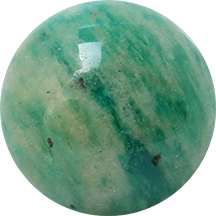
Amazonite is the green to blue-green variety of potassium feldspar, usually microcline (the name is sometimes also applied to green orthoclase), with the formula KAlSi₃O₈. Its color is usually attributed to small amounts of lead. It is also called Amazon stone (amazonstone).
Products made with this material
Showing 2 of 7 products
Full material guide
What the material is, where it comes from or how it is made, identification and care, from the cited sources.
Properties
| Mineral species | Microcline (potassium feldspar) |
| Chemical formula | KAlSi₃O₈ |
| Color | Pale green to dark green and blue-green, usually with white mottling |
| Crystal system | Triclinic |
| Refractive index | 1.522 to 1.530 |
| Birefringence | 0.008 |
| Specific gravity | 2.54 to 2.63 |
| Mohs hardness | 6 to 6.5 |
| Cleavage | Perfect, in two directions meeting at or near 90° |
| Luster | Vitreous (sometimes pearly on cleavage faces) |
| Transparency | Translucent to opaque |
Origins & sources
Amazonite occurs in pegmatites, granites and related rocks; well-formed crystals usually grow in pegmatites and cavities. Despite its name, there are no known sources within the Amazon rainforest or near the Amazon River. Brazil (Minas Gerais, Paraíba and Rio Grande do Norte) and Peru (Huancavelica) produce fine material; in the United States the Pikes Peak area of Colorado, where it is often found with smoky quartz, and Amelia Court House, Virginia, are known sources. Ethiopia has become a producer of top-quality amazonite. Other sources include Canada, China, Madagascar, Mozambique, Myanmar, Pakistan and Russia.
Identification
Amazonite is recognized by its green to bluish-green color, often interrupted by white streaks or a cross-hatched pattern, two directions of perfect cleavage meeting near 90°, and a pearly luster on some cleavage faces. Its refractive index (1.522–1.530) and specific gravity (about 2.54–2.63) are those of microcline. Mineralogists caution that the name is sometimes over-applied to slightly gray-green microcline.
Treatments include dyeing, wax impregnation, plastic coating and irradiation; the color is lost when the stone is heated above about 300 °C. "Amazon jade" is a misleading trade name: amazonite is a feldspar, not jadeite or nephrite.
Care
With a Mohs hardness of 6 to 6.5 and perfect cleavage, amazonite can be scratched in everyday wear and may break if struck. It is best suited to earrings, pendants and brooches; rings and bracelets benefit from protective (for example bezel) settings. Avoid steam and ultrasonic cleaning, which can widen internal fractures and remove coatings or fillers from treated stones. Clean with a soft brush, mild detergent and warm water.
History
Amazonite has been used since about 3000 BCE for decorations, amulets, vessels and beads; ancient examples have been found in Egypt, Mesopotamia and northern India, and it was counted among the six most precious stones in Pharaonic Egypt. A Babylonian cylinder seal carved from amazonite dates to the 15th century BCE. The stone has been linked by name with the Amazon since at least 1701, first as "Amazon stone". The mineralogist August Breithaupt formally named it amazonite in 1847, after an unspecified locality "near" the Amazon River.
Cultural meanings
Not collected yet
Traditional beliefs
Not collected yet
Collected Oct 22, 2026
- Amazonite: Mineral information, data and localities. Mindat.org (Hudson Institute of Mineralogy) · Accessed Oct 22, 2026 OverviewPropertiesIdentificationHistory
- Amazonite Value, Price, and Jewelry Information International Gem Society (Joel E. Arem, Ph.D., FGA) · Accessed Oct 22, 2026 OverviewPropertiesOrigins & sourcesIdentificationCareHistory
- Amazonite gemstone information Gemdat.org (Hudson Institute of Mineralogy) · Accessed Oct 22, 2026 PropertiesIdentification
- Amazonite: A bluish-green gem mineral. A microcline feldspar Geology.com (Hobart M. King, PhD, GIA Graduate Gemologist) · Accessed Oct 22, 2026 PropertiesOrigins & sourcesIdentificationCareHistory
- Amazonite - CAMEO Museum of Fine Arts, Boston (CAMEO materials database) · Accessed Oct 22, 2026 OverviewHistory