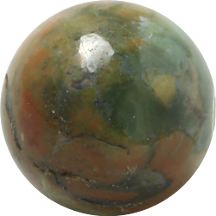
Rhyolite

Rhyolite is a natural rock, not a single mineral: an extrusive (volcanic) igneous rock with a very high silica content, the fine-grained equivalent of granite. It is made up mainly of quartz and feldspar (alkali feldspar such as sanidine, and plagioclase), with minor hornblende and biotite, in grains usually too small to see without a hand lens. Rhyolites with flow banding or spherulites are the ones most used as gem rocks.

Products made with this material

Category
Category
Color
Color

Colors are read from each product’s main photo.

Bead diameter (mm)
Bead diameter (mm)

Only round beads with a verified diameter. A product matches when its stated size range overlaps yours, limits included; a material matches when any of its round sizes does.

Price (USD)
Price (USD)
Availability

Showing 1 of 1 products

Full material guide
Material facts

What the material is, where it comes from or how it is made, identification and care, from the cited sources.

Properties

Nature Natural rock (extrusive igneous / volcanic)
Essential minerals Quartz, alkali feldspar and plagioclase; minor hornblende and biotite
Texture Aphanitic (very fine-grained), often porphyritic with quartz and feldspar phenocrysts; commonly flow-banded
Color Light gray, pink, yellowish, cream, mauve, tan to medium brown, light to brick red; mottled or banded patterns are common
Mohs hardness (effective) Over 5, typically 6 to 7
Specific gravity About 2.65

Origins & sources

Rhyolite forms when granitic magma erupts and cools quickly, usually in continental or continent-margin volcanic eruptions; it is rarely produced at oceanic eruptions, and most rhyolite occurs as lava flows. Gas trapped in the lava often leaves cavities (vugs) that can later host crystals, opal, agate or jasper. Much gem-quality rhyolite comes from Australia; a well-known US locality is near Truth or Consequences, Sierra County, New Mexico.

Identification

Rhyolite has the same general composition as granite but grains too small to distinguish by eye; geologists name hand specimens mainly by their quartz and salmon-colored K-feldspar phenocrysts. Trade names are applied loosely: sellers describe a pastel-green rock sold as "Rainforest Jasper" as rhyolite, banded rhyolite as "Wonderstone" (a term also misapplied to banded jasper and sandstone), and spherulitic rhyolite as "Birdseye". Liparite is an older European synonym. Obsidian and pumice have similar compositions but formed under different cooling conditions.

Care

Not collected yet

History & culture

History

The name rhyolite, from the Greek rhyax (stream of lava), was coined in 1860 by Baron Ferdinand von Richthofen, alluding to the flow banding typical of the rock; the synonym liparite was introduced in 1861 by Justus Roth for rocks of the Lipari Islands. Where better materials were not available, people used rhyolite to make stone tools such as scrapers, blades and projectile points.

Cultural meanings

Not collected yet

Traditional beliefs

Not collected yet

Sources

Collected Oct 23, 2026

  • Rhyolite: An extrusive igneous rock Geology.com (Hobart M. King) · Accessed Oct 23, 2026
    OverviewPropertiesOrigins & sourcesIdentificationHistory
  • Rhyolite Mindat.org (Hudson Institute of Mineralogy) · Accessed Oct 23, 2026
    OverviewPropertiesHistory
  • GemRocks: Rhyolite R. V. Dietrich, Central Michigan University (GemRocks) · Accessed Oct 23, 2026
    OverviewPropertiesOrigins & sourcesIdentificationHistory