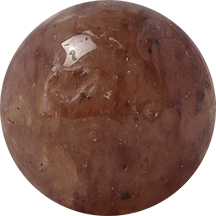
Muscovite

Muscovite is a natural potassium-aluminium mica, KAl₂(AlSi₃O₁₀)(OH)₂, and the most common member of the mica group. Pure thin sheets are colorless to silvery white, but impurities tint it; Mindat notes that pink to red muscovite can owe its color to manganese (Mn³⁺) rather than lithium. The dark pink to red-brown beads sold as "muscovite" in the crystal trade are described by the Japanese retailer Pascle as manganese-colored muscovite, which is consistent with this, although no laboratory test of those beads was found.

Products made with this material

Category
Category
Color
Color

Colors are read from each product’s main photo.

Bead diameter (mm)
Bead diameter (mm)

Only round beads with a verified diameter. A product matches when its stated size range overlaps yours, limits included; a material matches when any of its round sizes does.

Price (USD)
Price (USD)
Availability

Showing 1 of 1 products

Full material guide
Material facts

What the material is, where it comes from or how it is made, identification and care, from the cited sources.

Properties

Nature Natural mineral
Mineral group Mica group (dioctahedral micas)
Chemical formula KAl₂(AlSi₃O₁₀)(OH)₂
Color White to colorless, silvery white; tinted brown, yellow, green or rose by impurities
Cause of color Green: chromium (fuchsite); pink to red: can be manganese (Mn³⁺), not necessarily lithium
Crystal system Monoclinic
Mohs hardness 2.5 to 3 (2.5 parallel to the sheets, 4 across them)
Specific gravity 2.77 to 2.88
Refractive index nα 1.552–1.576, nβ 1.582–1.615, nγ 1.587–1.618
Birefringence 0.035 to 0.042
Cleavage Perfect on {001}; sheets are elastic
Luster Vitreous, silky, pearly

Origins & sources

Muscovite is a common primary mineral in many rock types: it is especially common in granitic rocks, forms large "books" in granite pegmatites, and grows during regional metamorphism of clay-rich rocks into mica schist and gneiss. In the 1700s sheets were mined from pegmatites around Moscow, Russia. The retailer Pascle lists Russia and China as sources of its red-brown beads.

Identification

Muscovite is identified by its perfect cleavage into thin, flexible, elastic, nearly colorless transparent sheets with a pearly to vitreous luster; Geology.com calls it the only common mineral with these properties. It may be confused with margarite and with lithium micas; a red or pink color alone does not prove lithium (lepidolite), so pink muscovite and lepidolite cannot be told apart by color alone. Green chromium-bearing muscovite is sold as fuchsite.

Care

Not collected yet

History & culture

History

Early names for muscovite include Muscovy glass, cat silver and lapis specularis ("stone mirror"), recorded in seventeenth-century and earlier texts. Its ability to split into large transparent sheets gave it an early use as window panes; panes mined near Moscow were called "Muscovy glass", the term thought to have inspired the name muscovite, which Johann Gottfried Schmeisser used by 1794.

Cultural meanings

Not collected yet

Traditional beliefs

Not collected yet

Sources

Collected Oct 23, 2026