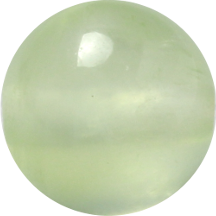
Prehnite

Prehnite is a natural calcium aluminium silicate mineral, Ca2Al2Si3O10(OH)2, usually pale green, yellowish green or yellow. It is mostly cut as translucent cabochons and beads; fully transparent material is extremely rare. Its Japanese and Chinese names, ぶどう石 and 葡萄石, mean "grape stone".

Products made with this material

Category
Category
Color
Color

Colors are read from each product’s main photo.

Bead diameter (mm)
Bead diameter (mm)

Only round beads with a verified diameter. A product matches when its stated size range overlaps yours, limits included; a material matches when any of its round sizes does.

Price (USD)
Price (USD)
Availability

Showing 1 of 1 products

Full material guide
Material facts

What the material is, where it comes from or how it is made, identification and care, from the cited sources.

Properties

Nature Natural mineral
Chemical formula Ca2Al2Si3O10(OH)2 (may contain Fe)
Crystal system Orthorhombic; crystals rare, usually massive, in crusts or druses
Mohs hardness 6–6.5
Specific gravity 2.80–3.00 (gem material usually 2.88–2.94)
Refractive index 1.611–1.665; birefringence 0.021–0.033
Color Pale to dark green, yellowish green, yellow, gray, white, colorless
Luster Vitreous to pearly
Cleavage Distinct in one direction

Origins & sources

Prehnite is a low-temperature mineral deposited from groundwater in cavities of basaltic rocks together with zeolites; it also forms hydrothermally in cavities of acid igneous rocks and in serpentine rocks. Its type locality is in the Karoo dolerites near Cradock, Eastern Cape, South Africa. Sources include New Jersey and Virginia (USA), Asbestos in Quebec (Canada), Scotland and Australia (facetable material), as well as France, Italy, Austria, Germany, Russia, South Africa, Pakistan and New Zealand.

Identification

On a refractometer prehnite usually gives a shadow edge near 1.63; its specific gravity is about 2.88–2.94 for gem material. It shows no pleochroism and may glow dull brownish yellow under UV light. Translucent material can look soft and velvety; chatoyant (cat's-eye) stones have been reported.

Care

Not collected yet

History & culture

History

Prehnite was named in 1788 by Abraham Gottlieb Werner in honor of the Dutch colonel Hendrik von Prehn, who is credited with discovering it in 1774 at the Cape of Good Hope and who brought the first specimens to Europe. It has been claimed to be the first mineral named after a person.

Cultural meanings

Not collected yet

Traditional beliefs

Not collected yet

Sources

Collected Oct 23, 2026