


Orange Calcite
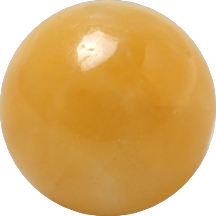
Orange calcite is a descriptive name for natural calcite (calcium carbonate, CaCO₃) of orange to orangy-yellow colour; it is a colour variety, not a separate mineral species. Gem laboratories have documented orangy-yellow calcite from Pakistan and Mexico and yellowish-orange calcite from the Czech Republic. The sources consulted do not establish a cause for the orange colour, and the Japanese retailer Pascle notes that the boundary with yellow calcite is not defined, so names vary between sellers.
Products made with this material
Showing 1 of 1 products
Full material guide
What the material is, where it comes from or how it is made, identification and care, from the cited sources.
Properties
| Material type | Natural mineral (colour variety of calcite) |
| Mineral species | Calcite |
| Chemical formula | CaCO₃ |
| Color | Orange to orangy yellow and yellowish orange |
| Crystal system | Trigonal |
| Mohs hardness | 3 |
| Specific gravity | 2.71 (pure) to 2.94 |
| Refractive index | 1.486 to 1.658 |
| Birefringence | 0.172 to 0.190 |
| Cleavage | Perfect rhombohedral, in three directions |
| Luster | Vitreous to pearly |
| Possible treatments | Dyeing, wax or plastic impregnation, irradiation |
Origins & sources
Calcite occurs in most geological settings and is most common as massive material in limestone and marble; it also forms in hydrothermal deposits. A dealer in Pakistan reported that large quantities of orangy-yellow (and green) calcite were being mined in Baluchistan province. Laboratory records also list orangy-yellow calcite from Rosarito Beach, Baja California, Mexico, yellowish-orange calcite from the Czech Republic and brownish-orange calcite from Erongo, Namibia.
Identification
Like all calcite, it has a Mohs hardness of 3, three directions of perfect rhombohedral cleavage and very strong birefringence (about 0.172), and it fizzes readily in acids, even weak ones such as vinegar. An orangy-yellow calcite cabochon from Pakistan at first resembled opal or chalcedony; testing gave a spot refractive index of about 1.56 with the strong birefringence blink typical of carbonates, a specific gravity of 2.72 and yellow fluorescence under long- and short-wave UV, and it showed wide bands with fine fibrous inclusions. It can resemble yellow to orange aragonite, a polymorph with the same formula; the Japanese retailer Pascle says the two cannot be told apart by eye. Aragonite is orthorhombic, denser (specific gravity about 2.95 against about 2.71) and has one distinct cleavage instead of three perfect rhombohedral ones. Calcite may be dyed, impregnated with wax or plastic, or irradiated, so a strong colour in inexpensive beads is not by itself proof of natural colour.
Care
Calcite (Mohs 3) scratches easily and splits readily along its cleavage. A care table based on GIA's Gem Reference Guide advises never using ultrasonic or steam cleaners; warm soapy water is usually safe. Keep it away from acids, which make it effervesce, and from high heat, at which it can crack apart (decrepitate). The same table lists natural calcite colours as stable to light.
History
The mineral name calcite comes from the Latin calx, "lime". Mindat describes it as an ancient name and credits Pliny the Elder (AD 79) with naming it as a mineral. Colour names such as this one are descriptive trade names, not separate mineral names.
Cultural meanings
The Japanese retailer Pascle writes that stones of the calcite group are said to settle unstable emotions and smooth relationships with other people, and recommends orange calcite as a charm for communication.
Traditional beliefs
Not collected yet
Collected Oct 23, 2026
- Calcite: Mineral information, data and localities. Mindat.org · Accessed Oct 23, 2026 PropertiesOrigins & sourcesIdentificationHistory
- Calcite Value, Price, and Jewelry Information International Gem Society · Accessed Oct 23, 2026 PropertiesIdentification
- Calcite Mineral | Uses and Properties Geology.com · Accessed Oct 23, 2026 Properties
- Special: Green and Orangy Yellow Calcite from Pakistan (reprint of a GIA Gems & Gemology eBrief item by Gagan Choudhary, Gem Testing Laboratory, Jaipur) Pala International · Accessed Oct 23, 2026 OverviewOrigins & sourcesIdentification
- Gemsdat: Calcite (compiled gemological test records) Gemsdat · Accessed Oct 23, 2026 OverviewPropertiesOrigins & sources
- Aragonite: Mineral information, data and localities. Mindat.org · Accessed Oct 23, 2026 Identification
- Calcite - Antique Jewelry University (gemological and care table citing GIA Gem Reference Guide, 1988) Lang Antiques · Accessed Oct 23, 2026 PropertiesIdentificationCare
- Pascle stone page: orange_calcite (retailer claims) Pascle (Japanese retailer) · Accessed Oct 23, 2026 OverviewIdentificationCultural meanings