


Aqua Aura Quartz
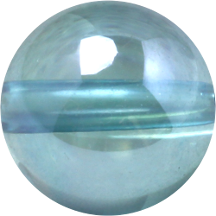
Aqua Aura is a trade name for treated natural quartz: colorless rock crystal coated with an extremely thin film of gold, which gives it a light blue to greenish-blue color and a strong iridescent sheen. The quartz itself is natural, but the color is artificial and lies only on the surface; it is not a natural blue stone and not aquamarine.
Products made with this material
Showing 1 of 1 products
Full material guide
What the material is, where it comes from or how it is made, identification and care, from the cited sources.
Properties
| Nature | Treated natural material: natural quartz with a gold surface coating |
| Base material | Quartz (colorless rock crystal), SiO₂ |
| Treatment | Thin-film gold coating applied by vacuum vapor deposition |
| Color | Light blue to greenish blue body color with violet, blue, green and yellow iridescence |
| Refractive index | 1.54 to 1.55 (as for quartz) |
| Specific gravity | About 2.66 (as for quartz) |
| Mohs hardness (tested surface) | 6.5 to 7 |
Origins & sources
This material is produced, not found in nature. Natural quartz crystals or beads are placed in a vacuum chamber and gold is evaporated so that its atoms deposit as a film on the quartz surface; the same technique is used to coat samples for electron microscopy. The thin gold film looks blue-green in transmitted light, which gives the blue color, while the iridescent colors depend on the film thickness. Coated quartz of this kind was first reported in the gem trade in 1988.
Identification
Gemological tests show ordinary quartz properties (refractive index about 1.54–1.55, specific gravity about 2.66, doubly refractive, inert to ultraviolet light). Under magnification the coating can be seen to vary in thickness, with color concentrated near crystal edges, little or no coating in surface pits, and small uncoated or worn areas showing colorless quartz. Laboratory analysis (EDXRF) identified the coating as gold.
Care
The color exists only in the surface film. In GIA testing of one crystal in 1989 the gold coating resisted acetone, heat and a hardness-6 point but was scratched by a hardness-7 point; GIA notes that thin-film coatings in general can scratch, especially along edges and facet junctions. Keep coated pieces away from hard or abrasive objects, avoid abrasive cleaners, and store them wrapped in soft material in a dry place.
History
GIA researchers first examined this coated quartz in the fall of 1988, when crystals and clusters from Bob Jackson Minerals of Renton, Washington, were being sold under the trade name "Aqua Aura" with promotional text describing them as natural quartz crystals coated with pure gold. Their 1989 report in The Journal of Gemmology confirmed that the coating is gold and described it as a spin-off of thin-film gold-coating technology.
Cultural meanings
Not collected yet
Traditional beliefs
Not collected yet
Collected Oct 23, 2026
- 'Aqua Aura' enhanced quartz specimens (R.C. Kammerling and J.I. Koivula), The Journal of Gemmology 21(6), 1989 Gem-A (The Gemmological Association of Great Britain); authors at GIA · Accessed Oct 23, 2026 OverviewPropertiesOrigins & sourcesIdentificationCareHistory
- How Does Vapor Deposition Create Mystic Topaz and Aqua Aura Quartz? International Gem Society · Accessed Oct 23, 2026 OverviewPropertiesOrigins & sources
- An Introduction to Gem Treatments GIA (Robert Weldon) · Accessed Oct 23, 2026 PropertiesCare