


Blue Aventurine
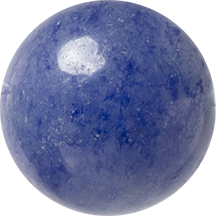
Blue aventurine is a blue colour variety of aventurine, a natural quartzite or quartz rock whose platy inclusions can make it glitter (aventurescence); included dumortierite, a blue borosilicate mineral, produces the blue colour. Much blue material in the bead trade shows little sparkle: the Japanese retailer Pascle says its blue aventurine is for that reason also called blue quartzite. It overlaps with dumortierite quartz, and blue quartz-based beads may also be dyed.
Products made with this material
Showing 1 of 1 products
Full material guide
What the material is, where it comes from or how it is made, identification and care, from the cited sources.
Properties
| Nature | Natural rock: quartzite or massive quartz with platy mineral inclusions |
| Main mineral | Quartz (SiO₂) |
| Cause of colour | Included dumortierite, a blue borosilicate mineral |
| Mohs hardness | 6.5 to 7 (lower when mica inclusions are abundant) |
| Specific gravity | 2.6 to 2.7 (can be higher if heavily included) |
| Refractive index | 1.544 to 1.553 |
| Luster | Vitreous, aventurescent |
| Transparency | Translucent to nearly opaque |
| Common treatments | Often oiled or dyed; quartz without aventurescence is also dyed and sold as aventurine |
Origins & sources
India is by far the most important commercial producer of aventurine and Brazil is second; smaller amounts come from Russia, Spain, Austria and Tanzania. Aventurine is a variety of quartzite, a metamorphic rock formed when quartz sandstone or chert recrystallizes into a tight network of quartz grains. Geology.com illustrates blue aventurescent quartz from India. Blue dumortierite quartzites used as ornamental stone are also mined in Brazil, Mozambique and Madagascar.
Identification
Natural blue colour in quartz rock can look like dye. In one Gems & Gemology report, a blue dumortierite-quartz rock submitted as sapphire showed blue concentrated between white quartz grains, as in dyed material, but reflected light revealed blue dumortierite grains with a different luster, the specific gravity was 2.99 (quartz is about 2.65), and Raman analysis confirmed dumortierite and quartz. By contrast, blue beads that GIA reported as composites of dyed quartzite pieces held in polymer showed dye in their many fractures, a red reaction under the Chelsea filter and a band near 650 nm in the spectroscope. Dyeing of quartz is common and dye concentrations can be seen with magnification.
Care
Aventurine has the hardness of quartz (6.5 to 7), but abundant mica can lower its apparent hardness and give it a direction of easier breakage, and coarse mica flakes can pluck out of a polished surface and leave pits. IGS lists no special care for quartz, but notes that some dyes used on quartz fade, which matters for the oiled or dyed beads that are common in the trade.
History
Mindat derives the name from the Italian "a ventura", meaning "by chance", and links it to aventurine glass, a glittering glass with copper inclusions first made in Italy. Mindat also notes that "aventurine" is used commercially for several kinds of stones, including aventurine feldspar (sunstone); the natural quartz material is also called aventurine quartz and is not to be confused with aventurine glass (goldstone).
Cultural meanings
The Japanese retailer Pascle writes that blue aventurine, like green aventurine, is said to ease stress and tension, and that it is believed to calm the emotions and soften anxiety.
Traditional beliefs
Not collected yet
Collected Oct 23, 2026
- Aventurine: A translucent quartz with a sparkle of mica Geology.com (Hobart M. King, PhD, GIA Graduate Gemologist) · Accessed Oct 23, 2026 OverviewPropertiesOrigins & sourcesCare
- Quartzite: Metamorphic Rock - Pictures, Definition & More Geology.com · Accessed Oct 23, 2026 OverviewPropertiesOrigins & sources
- Aventurine: Mineral information, data and localities Mindat.org (Hudson Institute of Mineralogy) · Accessed Oct 23, 2026 OverviewPropertiesHistory
- Quartz Value, Price, and Jewelry Information International Gem Society (Joel E. Arem, Ph.D., FGA) · Accessed Oct 23, 2026 OverviewPropertiesIdentificationCare
- Dumortierite-Quartz Rock Presented as Sapphire (Gems & Gemology Gem News) GIA (Gagan Choudhary) · Accessed Oct 23, 2026 Identification
- Attractive Composite Quartz Beads (Gems & Gemology Gem News) GIA (Gagan Choudhary) · Accessed Oct 23, 2026 OverviewIdentification
- Chemical determination of coloured zoned minerals in 'natural stones' by EDS/WDS electron microprobe: an example from dumortierite quartzites (X-Ray Spectrometry, 2003, abstract) Borghi et al., X-Ray Spectrometry (Wiley) · Accessed Oct 23, 2026 OverviewPropertiesOrigins & sources
- Pascle stone page: blue_aventurine Pascle (Japanese retailer; trade claims only) · Accessed Oct 23, 2026 OverviewCultural meanings