


Aragonite
Aragonite is a natural calcium carbonate mineral (CaCO₃) with the same chemical formula as calcite but a different, orthorhombic crystal structure; the two are polymorphs. It is the second most common natural form of calcium carbonate, metastable relative to calcite, and often converts to calcite over time. It is also a main constituent of pearl and shell nacre and of ammolite.
Products made with this material
Showing 1 of 1 products
Full material guide
What the material is, where it comes from or how it is made, identification and care, from the cited sources.
Properties
| Material type | Natural mineral |
| Mineral species | Aragonite (polymorph of calcite) |
| Chemical formula | CaCO₃ (may contain Pb, Sr, rarely Zn) |
| Color | Colourless, white, yellow, grey, green, blue-green, lavender, reddish, brown |
| Crystal system | Orthorhombic |
| Mohs hardness | 3.5 to 4 |
| Specific gravity | 2.947 (pure); usually 2.93 to 2.95, up to 3.0 with lead |
| Refractive index | 1.530 to 1.685 (biaxial negative) |
| Birefringence | 0.155 to 0.156 |
| Cleavage | Distinct in one direction |
| Luster | Vitreous to resinous |
| Transparency | Transparent to opaque |
Origins & sources
Aragonite is nearly always a low-temperature, near-surface mineral. It forms as cave deposits (speleothems) in limestone, as sinters and layered deposits at hot springs and geysers, as seafloor oolites, in altered serpentinites and in the oxidized zones of ore deposits. The type locality is Molina de Aragón, Spain. Other notable gem sources include Bílina (Czech Republic), Laurium (Greece, blue aragonite), Agrigento (Sicily, with sulfur crystals), Chile (blue material), Guanajuato (Mexico) and several US states.
Identification
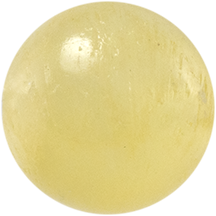
Aragonite is separated from calcite by its orthorhombic, often twinned crystals, higher specific gravity (about 2.95 against about 2.71), biaxial optics and a single distinct cleavage instead of calcite's three perfect rhombohedral cleavages; both show strong birefringence and facet doubling. Heating to about 400 °C converts aragonite to calcite. Its fluorescence is variable (for example pale rose, yellow or bluish under long-wave UV). The Japanese retailer Pascle says that in the crystal-shop trade "aragonite" usually means yellow material, that other colours carry a colour prefix (blue aragonite, green aragonite), and that it cannot be told from material sold as yellow or orange calcite by eye. Ammolite is sometimes described as aragonite, but aragonite is only its main constituent.
Care
With a Mohs hardness of 3.5 to 4, aragonite is too soft to be worn safely in most jewellery. Avoid mechanical cleaning such as steam or ultrasonic cleaners; clean it with a soft brush, mild detergent and warm water, and store it apart from other stones to avoid scratches.
History
Abraham Gottlob Werner named aragonite in 1797 after its type locality, the village of Molina de Aragón in Spain; Mindat notes that naming it after the province of Aragón is a mistake made by several later writers.
Cultural meanings
The Japanese retailer Pascle writes that aragonite is said to heighten its wearer's charm and presence in face-to-face meetings and calls it a "stone of connections" that is said to help build relationships, recommending it as a charm for communication.
Traditional beliefs
Not collected yet
Collected Oct 23, 2026
- Aragonite: Mineral information, data and localities. Mindat.org · Accessed Oct 23, 2026 OverviewPropertiesOrigins & sourcesIdentificationHistory
- Aragonite Value, Price, and Jewelry Information International Gem Society · Accessed Oct 23, 2026 OverviewPropertiesOrigins & sourcesIdentificationCare
- Calcite: Mineral information, data and localities. Mindat.org · Accessed Oct 23, 2026 Identification
- Pascle stone page: aragonite (retailer claims) Pascle (Japanese retailer) · Accessed Oct 23, 2026 IdentificationCultural meanings