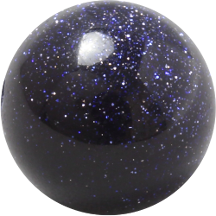
Blue Goldstone

Blue goldstone is a man-made glass, not a natural stone or mineral. It is the dark blue colour of goldstone (aventurine glass): the glass is coloured blue by cobalt, and tiny flat metallic crystals inside it give a starry, silvery sparkle. Despite the name it contains no gold, and it is not natural blue aventurine quartz or lapis lazuli, which it can resemble.

Products made with this material

Category
Category
Color
Color

Colors are read from each product’s main photo.

Bead diameter (mm)
Bead diameter (mm)

Only round beads with a verified diameter. A product matches when its stated size range overlaps yours, limits included; a material matches when any of its round sizes does.

Price (USD)
Price (USD)
Availability

Showing 1 of 1 products

Full material guide
Material facts

What the material is, where it comes from or how it is made, identification and care, from the cited sources.

Properties

Nature Man-made glass
Family Goldstone (aventurine glass)
Composition Glass coloured blue by cobalt, containing small metallic crystals (copper crystals were identified in a cobalt-blue sample)
Color Dark blue with silvery-grey metallic sparkle
Structure Amorphous (glass)
Refractive index (goldstone) 1.530 to 1.550
Specific gravity (goldstone) 2.50 to 2.80
Mohs hardness (goldstone) About 6 or slightly less

Origins & sources

Blue goldstone is made in glassworks, not mined. Goldstone glass is melted with metal compounds and cooled slowly in an oxygen-poor (reducing) atmosphere so that metallic crystals grow inside it; for the blue variety, cobalt is added to colour the glass. A version with copper crystals in a dark blue glass was developed in Venice (Murano) in the late 19th century. Today much of the goldstone sold as a gem and lapidary material comes from factories in China.

Identification

In blue goldstone the blue comes from the glass itself, and the crystals tend to look silvery rather than coppery. Under 20x magnification the metallic crystals are easy to see; their uniform shape, uniform size and even distribution through the glass separate goldstone from natural aventurine quartz and sunstone. Blue goldstone can resemble lapis lazuli. Gas bubbles, as in other glass, are sometimes visible.

Care

Not collected yet

History & culture

History

According to a 2013 study of Venetian aventurine glass by Moretti, Gratuze and Hreglich, the variety with copper crystals in a dark blue glass is attributed to the Murano glassmaker Vincenzo Moretti around 1885. The same study notes that an older Venetian recipe already added zaffre (a cobalt oxide preparation), anticipating the blue version by more than a century. Blue goldstone shares the longer history of goldstone, which began in 17th-century Murano.

Cultural meanings

Not collected yet

Traditional beliefs

Not collected yet

Sources

Collected Oct 23, 2026