


Red Phantom Quartz
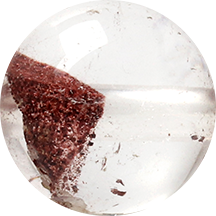
Red phantom quartz is natural quartz containing a red to brown "phantom": the outline of an earlier growth stage of the crystal, traced by a thin layer of iron-oxide inclusions, usually hematite. The Quartz Page illustrates an orange-red hematite phantom in quartz from the Orange River, Namibia, and GIA lists limonite among the minerals that can coat earlier crystal faces in phantom quartz.
Products made with this material
Showing 1 of 1 products
Full material guide
What the material is, where it comes from or how it is made, identification and care, from the cited sources.
Properties
| Nature | Natural material: quartz with a phantom (growth feature, not a separate mineral) |
| Phantom-forming minerals | Iron oxides, mainly hematite (Fe₂O₃); limonite is also reported |
| Color | Colorless quartz with red to brown phantom layers |
| Host mineral | Quartz, SiO₂ |
| Crystal system | Trigonal (quartz) |
| Mohs hardness | 7 (quartz host) |
| Specific gravity | 2.65 to 2.66 (quartz) |
| Refractive index | 1.544 to 1.553 (quartz) |
Origins & sources
A phantom forms when minerals settle on a growing crystal for a time and are later enclosed as growth resumes (The Quartz Page). Hematite forms in many environments under oxidizing conditions, mostly at medium temperatures, and is red in fine aggregates and thin crystals; The Quartz Page illustrates a hematite phantom that precipitated on the faces of quartz from the Orange River in southern Namibia. The retailer Pascle gives Brazil as the main source of its material.
Identification
In a true phantom the inner "ghost" crystal has the same axis as its host. GIA (Gems & Gemology, 2020) described imitation phantom quartz made by laser engraving natural rock crystal: the "phantom" consisted of regular networks of tiny cracks, its orientation did not match the crystal's optic axis in a polariscope, and the cracks seemed to reduce the stone's toughness; such imitations are readily identified with a microscope and polariscope. Mindat notes that a sharp change in colour or opacity can also look like a phantom without any mineral layer. The Quartz Page notes that red inclusions in quartz once called lepidocrocite have been found to be hematite.
Care
IGS lists no special care instructions for quartz. The retailer Pascle advises not leaving it wet and wiping it gently with a soft cloth when dirty.
History
Not collected yet
Cultural meanings
The retailer Pascle says phantom quartz is regarded as a symbol of growth and progress, and that red phantom quartz is associated with vitality and is kept as a charm for fertility and safe childbirth. Pascle also says it is called "Aka-Fuji" (red Fuji), after the rare reddening of Mount Fuji at sunrise, which is considered very auspicious in Japan. These are retailer beliefs, not verified properties.
Traditional beliefs
Not collected yet
Collected Oct 23, 2026
- The Quartz Page: Inclusions The Quartz Page (S. Schorn) · Accessed Oct 23, 2026 OverviewPropertiesOrigins & sourcesIdentification
- A New Phantom Quartz Imitation: Laser-Engraved Rock Crystal GIA, Gems & Gemology · Accessed Oct 23, 2026 OverviewPropertiesIdentification
- Definition of phantom crystal Mindat.org (Hudson Institute of Mineralogy) · Accessed Oct 23, 2026 Identification
- The Quartz Page: Growth Forms The Quartz Page (S. Schorn) · Accessed Oct 23, 2026 OverviewOrigins & sources
- Quartz: Mineral information, data and localities Mindat.org (Hudson Institute of Mineralogy) · Accessed Oct 23, 2026 Properties
- Quartz Value, Price, and Jewelry Information International Gem Society · Accessed Oct 23, 2026 Care
- レッドファントムクォーツ|天然石・パワーストーン通販 Pascle(パスクル) (retailer page) Pascle (retailer; trade claims only) · Accessed Oct 23, 2026 PropertiesOrigins & sourcesCareCultural meanings