Rhodolite
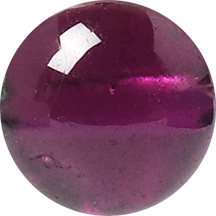
Rhodolite is a natural purplish red garnet whose composition lies in the pyrope–almandine series. Mindat notes that the name originally meant a rose-red gem variety of pyrope but now covers pink to purplish garnets in that series, many of them closer to almandine. IGS stresses that the purplish red hue, not an exact recipe, defines rhodolite, and that small amounts of other garnet species are always present.
Products made with this material
Showing 1 of 1 products
Full material guide
What the material is, where it comes from or how it is made, identification and care, from the cited sources.
Properties
| Nature | Natural mineral (garnet variety) |
| Mineral species | Garnet group, pyrope–almandine series |
| Chemical formula | (Mg,Fe)₃Al₂(SiO₄)₃ |
| Color | Purplish red, red-purple, reddish purple |
| Crystal system | Isometric (cubic) |
| Refractive index | 1.745–1.761 |
| Birefringence | None (singly refractive) |
| Specific gravity | 3.79–3.89, depending on locality |
| Mohs hardness | 7–7.5 |
| Cleavage | None |
| Dispersion | 0.026 |
Origins & sources
IGS lists Brazil, India, Madagascar, Sri Lanka, Tanzania and Zimbabwe as the principal sources of gem rhodolite, with other sources including Kenya, Mozambique, Myanmar and North Carolina in the United States. The type locality in Cowee Valley, Macon County, North Carolina, where rhodolite was found in stream sands, usually yields small stones, while African finds have produced gems over 75 carats.
Identification
Rhodolite is singly refractive, shows an almandine-type absorption spectrum and may react strongly to a magnet, which helps quick separations but is not a positive identification. Gem rhodolites are typically free of eye-visible inclusions. Not every purplish red garnet is a rhodolite; chemical analysis is needed to confirm an almandine–pyrope mix. Rhodolites typically receive no treatments, and so-called "synthetic rhodolite" sold online is often glass or colored cubic zirconia.
Care
GIA notes that garnets are stable to light and chemicals but can be attacked by hydrofluoric acid; they have fair to good toughness and should be protected from hard blows. Warm, soapy water is always safe, an ultrasonic cleaner is usually safe except for fractured stones, and steam cleaning is not recommended. Garnets might rarely be fracture-filled; such stones should be cleaned only with warm, soapy water. IGS adds that tiny inclusions may burst under extreme heat or ultrasound, so a soft brush, mild detergent and warm water are preferable to mechanical cleaning.
History
Rhodolite was described as a new variety of garnet by W. E. Hidden and J. H. Pratt in 1898, from stream sands at Mason's Branch in Cowee Valley, North Carolina. The name is usually traced to the Greek rhodon, "rose"; some link it to the rhododendron flower, whose name has the same root.
Cultural meanings
Not collected yet
Traditional beliefs
Garnet is the birthstone for January and the gem of the second wedding anniversary.
Collected Oct 23, 2026
- Garnet Description GIA · Accessed Oct 23, 2026 Overview
- Garnet Gemstone | Garnet Stone GIA · Accessed Oct 23, 2026 PropertiesTraditional beliefs
- Rhodolite: Mineral information, data and localities Mindat · Accessed Oct 23, 2026 OverviewPropertiesOrigins & sourcesHistory
- Rhodolite Garnet Value, Price, and Jewelry Information International Gem Society · Accessed Oct 23, 2026 OverviewPropertiesOrigins & sourcesIdentificationCareHistory
- Garnet Care and Cleaning Guide GIA · Accessed Oct 23, 2026 Care
