


Pietersite
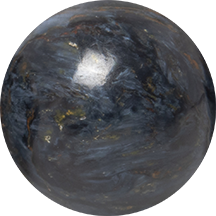
Pietersite is a natural brecciated rock (a gem material, not a single mineral species) made of fine-grained quartz or chalcedony with embedded fibres of crocidolite, an amphibole, in various stages of alteration to iron oxides. The fibres give it a chaotic, multi-directional chatoyancy in blue-gray, golden yellow, brown and red. It is often described as a brecciated tiger's eye or hawk's eye; mineral databases classify it as a variety of chalcedony. It is also called Tempest stone.
Products made with this material
Showing 1 of 1 products
Full material guide
What the material is, where it comes from or how it is made, identification and care, from the cited sources.
Properties
| Material type | Natural rock (brecciated gem material) |
| Composition | Microcrystalline quartz/chalcedony (SiO₂) with a few weight percent or less of crocidolite (magnesioriebeckite) fibres, hematite and goethite; minor calcite |
| Color | Blue-gray, golden yellow to brown and brownish red |
| Refractive index | 1.54 to 1.55 |
| Specific gravity | 2.50 to 2.58 (Namibia); 2.67 to 2.74 (China) |
| Transparency | Semitranslucent to opaque (Namibia); opaque (China) |
| Optical effect | Chaotic chatoyancy in patches with differing fibre orientation |
Origins & sources
Gem-quality pietersite is known from two main sources. In Namibia it was found in rounded dolostone cobbles on farmland near Outjo, in the Kuraman district (Mindat lists Hopewell Farm 240, Outjo, Kunene Region); researchers interpret it as a solution breccia formed when silica-rich fluids dissolved and replaced the dolomite, after which crocidolite grew from reactions between chalcedony and hematite. In China it comes from Xichuan, Henan Province, where it was discovered in 1966 during prospecting for crocidolite (another source reports a similar rock from Nangang, Hunan Province). By 2010 both mining areas appeared to be closed, although material continued to reach the market.
Identification
Pietersite is recognised by angular chatoyant fragments cemented in irregular patches, giving swirling, storm-like flashes instead of the continuous parallel bands of tiger's eye. Its refractive index (about 1.54) is that of quartz. Namibian material is mostly blue-gray and golden yellow with a lower specific gravity (2.50–2.58) and usually fluoresces green under UV light; Chinese material is mostly jasper-like brownish red with weaker chatoyancy and a higher specific gravity (2.67–2.74). Open spaces in some polished pieces have reportedly been filled with wax or glue during finishing.
Care
Jewelers commonly recommend cleaning these tiger's eye–related materials only with a polishing cloth rather than alcohol, steam or an ultrasonic cleaner, and note that they chip or break more readily than many gems when struck.
History
Pietersite is named after Sid Pieters, a gem and mineral dealer who first described it in 1962 after finding it while prospecting near Outjo, Namibia. He registered the gem in the mineral records of Great Britain in 1964 and brought it to market in the 1970s; by 1996 much of the minable Namibian stock was reported to be depleted. Chinese pietersite, discovered in 1966, was mined in the 1970s and 1980s but reached the market only in the 1990s. The Japanese retailer Pascle explains the alternative name Tempest stone by its storm-like pattern.
Cultural meanings
The Japanese retailer Pascle says pietersite is believed to give its owner a chance to look at themselves objectively and to sharpen intuition and insight, and it markets the stone as a charm for reaching goals, such as in exams or at work.
Traditional beliefs
Not collected yet
Collected Oct 23, 2026
- A Microstructural Study of Pietersite from Namibia and China (Gems & Gemology, Winter 2010) GIA (Kaifan Hu and Peter J. Heaney) · Accessed Oct 23, 2026 OverviewPropertiesOrigins & sourcesIdentificationHistory
- A Microstructural Study of Pietersite from Namibia and China | Gems & Gemology GIA · Accessed Oct 23, 2026 OverviewOrigins & sources
- Pietersite: Mineral information, data and localities. Mindat.org (Hudson Institute of Mineralogy) · Accessed Oct 23, 2026 OverviewPropertiesOrigins & sources
- Pietersite gemstone information Gemdat.org (Hudson Institute of Mineralogy) · Accessed Oct 23, 2026 OverviewPropertiesHistory
- GemRocks: Hawk's Eye & Tiger's Eye Central Michigan University (GemRocks) · Accessed Oct 23, 2026 OverviewOrigins & sourcesIdentificationCareHistory
- ピーターサイト (Pietersite) — supplier/trade claim Pascle (Japanese retailer) · Accessed Oct 23, 2026 HistoryCultural meanings