


Jadeite
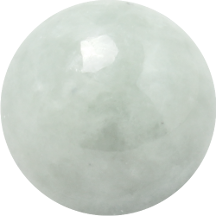
Jadeite is a natural rock made of tiny interlocking crystals of the pyroxene mineral jadeite (NaAlSi₂O₆), and it is one of the two classic materials called jade. The other, nephrite, is a different material made of amphibole minerals; the two look alike, which is why both were long sold as "jade", but the French mineralogist Alexis Damour separated them in 1863. In Chinese, 翡翠 (fei cui) is a traditional term for jadeite jade, though in parts of Asia it is also applied to kosmochlor and omphacite. Jadeite is generally the rarer and more valuable of the two.
Products made with this material
Showing 1 of 1 products
Full material guide
What the material is, where it comes from or how it is made, identification and care, from the cited sources.
Properties
| Nature | Natural rock (fine-grained aggregate of jadeite crystals) |
| Main mineral | Jadeite (a pyroxene); not nephrite, which is an amphibole |
| Chemical formula | NaAlSi₂O₆ (iron may replace part of the aluminium) |
| Color | Many shades of green; also white, lavender, yellow, reddish orange, brown, gray, black and rarely blue; color is often uneven |
| Crystal system | Monoclinic; crystals very rare, usually massive and granular |
| Mohs hardness | 6.5 to 7 |
| Toughness | Exceptionally tough because of its interlocking crystals |
| Refractive index | 1.666 to 1.680 (GIA); spot reading usually about 1.66 |
| Specific gravity | About 3.34 (range 3.25 to 3.36) |
| Luster | Vitreous; polished surfaces vitreous to greasy |
Origins & sources
Jadeite occurs chiefly in serpentine rock derived from olivine-rich rocks, and also as alluvial boulders and pebbles; one rough jadeite boulder from Myanmar weighed 23 metric tons. Myanmar (Burma) is the source of the finest "imperial jade". Other sources include Guatemala, Russia (including fine chromium-rich material from the Kantegir River, West Sayan), San Benito County in California, Japan, Kazakhstan, Mexico, Turkey, France and Italy.
Identification
Jadeite and nephrite look alike but can be told apart by testing: jadeite has a higher refractive index (about 1.66 against about 1.61–1.63) and specific gravity (about 3.34 against about 2.95). Jadeite also shows a diagnostic absorption line at 437.5 nm, while deep green material shows a chromium spectrum instead. Some green omphacite has the same gemological properties as jadeite and needs Raman spectroscopy to identify. Jadeite is often treated: "A" jade is untreated (it may only be waxed), "B" jade is bleached and polymer-impregnated, "C" jade is dyed, and "B+C" is both. Lookalikes sold under misleading "jade" names include serpentine ("Korean jade"), aventurine quartz ("Indian jade"), idocrase ("American jade"), hydrogrossular garnet ("Transvaal jade") and dyed marble ("Mexican jade").
Care
With a Mohs hardness of 6.5 to 7 and exceptional toughness, jadeite wears well, even in rings. Untreated jadeite may withstand mechanical cleaning, but acid-treated ("B") jadeite can develop cracks. If the treatment history is unknown, clean it only with warm water, mild detergent and a soft brush, or have it examined by a gemological laboratory.
History
In Central America the Olmecs, Maya and Aztecs prized jadeite for jewelry, ornaments and religious objects; according to GIA, early Spanish explorers saw people holding it to their sides to relieve pain, and named it piedra de ijada, "stone of the pain in the side", the origin of the word jade. China had worked nephrite for thousands of years; jadeite arrived from Burma (now Myanmar) in the 18th century, and Chinese carvers of the late 18th and early 19th centuries made masterpieces from it. The Chinese called nephrite yu and Burmese jadeite fei-ts'ui, while European traders grouped both as "jade" until Damour separated the two minerals in 1863. Jade is the official gem of the 12th wedding anniversary.
Cultural meanings
According to GIA, jadeite is regarded as a symbol of prosperity, success and good luck, and the Chinese associate jade with clarity of mind and purity of spirit; Confucius wrote that jade is like virtue. These are cultural associations, not tested properties.
Traditional beliefs
Traditional motifs still carved in jadeite and nephrite carry symbolic meanings in Chinese tradition: the bat symbolizes happiness, the butterfly long life, the dragon power, prosperity and goodness, the peach immortality, and the bi, a flat disk with a hole in the center, heaven.
Collected Oct 23, 2026
- What Is Jade Gemstone | Jade Stone – GIA GIA · Accessed Oct 23, 2026 OverviewPropertiesIdentificationHistoryCultural meanings
- Jade Description GIA · Accessed Oct 23, 2026 OverviewPropertiesOrigins & sourcesIdentification
- Jade History and Lore GIA · Accessed Oct 23, 2026 HistoryCultural meaningsTraditional beliefs
- Jadeite Value, Price, and Jewelry Information International Gem Society · Accessed Oct 23, 2026 OverviewPropertiesOrigins & sourcesIdentificationCareHistory