


Chondrite
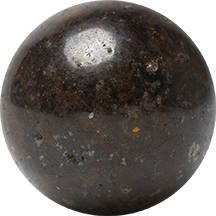
Chondrites are stony meteorites, natural extraterrestrial rocks named after the chondrules they contain: small, nearly spherical silicate droplets that formed in the early solar system. At over 4.5 billion years old they are among the most primitive rocks known and have never been melted. They are the most common meteorites, about 86% of all meteorites recovered.
Products made with this material
Showing 1 of 1 products
Full material guide
What the material is, where it comes from or how it is made, identification and care, from the cited sources.
Properties
| Nature | Natural extraterrestrial rock (stony meteorite) |
| Composition | Chondrules of silicate minerals in a fine-grained matrix, with small grains of iron-nickel metal and sulfides; some contain calcium-aluminium-rich inclusions (CAIs) |
| Main classes | Ordinary (H, L, LL), carbonaceous and enstatite chondrites |
| Age | Over 4.5 billion years |
| Weight | Most weigh about one and a half times as much as Earth rocks of similar size |
| Magnetism | Most attract a magnet weakly because of their metal grains |
Origins & sources
Chondrules formed when clumps of dust in the solar nebula, the disc of gas and dust around the young Sun, melted briefly and solidified; chondrules, metal grains and dust then accreted into asteroids. Because chondrites come from bodies that never melted, their chemistry has changed little since the solar system formed, although most were later altered by heating or water on their parent asteroids. The different classes come from different asteroids. Ordinary chondrites, the most abundant class, make up about 74% of observed falls, according to the UCLA Meteorite Museum.
Identification
Freshly fallen chondrites have a thin black fusion crust, often with rounded thumbprint-like dimples, over a grey interior; weathering on Earth turns the crust rusty brown over decades or centuries. Chondrules (mean sizes about 0.3–1 mm) are visible on cut surfaces, and grinding a corner usually reveals tiny shiny flecks of metal. Most attract a magnet weakly, but magnetism alone does not prove a meteorite: magnetite, the material most often mistaken for meteorites, is magnetic and gives a black streak. Martian and lunar meteorites are achondrites, not chondrites. The Japanese retailer Pascle says most chondrite sold as beads is the Sahara meteorite NWA 869 and calls it Martian; the Meteoritical Bulletin, however, classifies Northwest Africa 869 (found 2000, about 2 t) as an L3-6 ordinary chondrite.
Care
Not collected yet
History
Not collected yet
Cultural meanings
Not collected yet
Traditional beliefs
Not collected yet
Collected Oct 23, 2026
- Chondrites Buseck Center for Meteorite Studies, Arizona State University · Accessed Oct 23, 2026 OverviewPropertiesOrigins & sources
- Types of meteorites Natural History Museum, London · Accessed Oct 23, 2026 OverviewPropertiesOrigins & sourcesIdentification
- Frequently Asked Questions UCLA Meteorite Museum · Accessed Oct 23, 2026 PropertiesOrigins & sourcesIdentification
- Meteoritical Bulletin Database: Northwest Africa 869 Meteoritical Society / Lunar and Planetary Institute · Accessed Oct 23, 2026 Identification
- Case 2: Carbonaceous and Ordinary Chondrites UCLA Meteorite Museum · Accessed Oct 23, 2026 PropertiesOrigins & sources
- Teacher's Guide to the UCLA Meteorite Museum UCLA Meteorite Museum · Accessed Oct 23, 2026 Origins & sourcesIdentification
- コンドライト Pascle (retailer; trade claim) · Accessed Oct 23, 2026 Identification