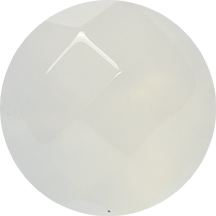
White Chalcedony
White chalcedony is natural chalcedony, the microcrystalline form of quartz (SiO₂), in a white to off-white color. Pure chalcedony is white, gray or bluish; other colors come from included minerals. In the gem trade the plain name "chalcedony" is used for translucent stones of a single color, and white is one of the colors sold this way.
Products made with this material
Showing 2 of 2 products
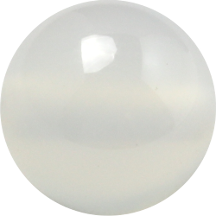
Full material guide
What the material is, where it comes from or how it is made, identification and care, from the cited sources.
Properties
| Mineral species | Quartz (chalcedony, microcrystalline variety) |
| Chemical formula | SiO₂ |
| Crystal system | Trigonal (microcrystalline aggregate) |
| Mohs hardness | 6.5 to 7 |
| Specific gravity | About 2.6 (varies with impurities) |
| Luster | Waxy to dull (vitreous when polished) |
| Transparency | Translucent |
| Fracture | Conchoidal; no cleavage |
| Color | White to off-white, also grayish |
Origins & sources
Chalcedony forms at relatively low temperatures from silica-rich waters, commonly as botryoidal crusts lining or filling cavities and fissures in volcanic rocks, and also in sedimentary rocks. White chalcedony "roses" weather out of volcanic rock in places such as the Mopah Range of the Turtle Mountains, California, and occur in Irai, Rio Grande do Sul, Brazil.
Identification
White chalcedony shows the waxy luster, translucency, lack of cleavage and quartz hardness of all chalcedony, with a refractive index of about 1.54 to 1.55 and specific gravity near 2.6. "Chinese opal" is a misnomer sometimes applied to white chalcedony; it is not opal. Chalcedony is porous and light-colored material is easily dyed, so pale chalcedony is also the usual starting material for dyed colors.
Care
Chalcedony is a tough gem suitable for all kinds of jewelry and needs no special care. Clean it with mild detergent, warm water and a soft brush.
History
These records concern chalcedony in general rather than this color specifically. The name is generally traced to the ancient port of Chalcedon, now Kadıköy in Istanbul, Turkey; Agricola mentioned a stone named for the town in 1546. Chalcedony was used for cylinder seals in Mesopotamia as early as the 7th century BC and later for jewelry, buttons, cameos and intaglios.
Cultural meanings
Not collected yet
Traditional beliefs
Chalcedony in general was traditionally believed to drive away melancholy and evil spirits; Merrill (1922) recorded the belief that, worn as an amulet, it guarded against danger during tempests. It is also listed in the Bible (Revelation 21:19) as the third foundation stone of the Heavenly City.
Collected Oct 23, 2026
- Chalcedony: Mineral information, data and localities. Mindat.org (Hudson Institute of Mineralogy) · Accessed Oct 23, 2026 OverviewPropertiesHistory
- The Quartz Page: Chalcedony The Quartz Page (A. C. Akhavan) · Accessed Oct 23, 2026 OverviewPropertiesOrigins & sources
- GemRocks: Chalcedony Central Michigan University (R. V. Dietrich, GemRocks) · Accessed Oct 23, 2026 PropertiesOrigins & sourcesIdentificationHistoryTraditional beliefs
- Chalcedony Value, Price, and Jewelry Information International Gem Society (Joel E. Arem, Ph.D., FGA, et al.) · Accessed Oct 23, 2026 PropertiesIdentificationCareHistory
- Chalcedony – A Gem for the Ages Ganoksin / Colored Stone (Gordon Austin, April 2003) · Accessed Oct 23, 2026 Overview