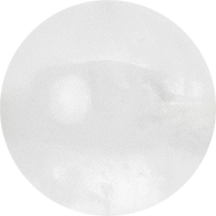
Milky Quartz
Milky quartz is a natural variety of crystalline quartz (SiO₂) that is white and translucent to almost opaque. The white colour is not a pigment: it comes from countless evenly distributed tiny gas and/or fluid inclusions that scatter light. It is also called milk quartz or snow quartz, and the term is sometimes used for white, massive vein quartz.
Products made with this material
Showing 2 of 2 products
Full material guide
What the material is, where it comes from or how it is made, identification and care, from the cited sources.
Properties
| Material type | Natural mineral: white variety of quartz |
| Chemical formula | SiO₂ |
| Cause of colour | Myriad tiny gas (CO₂) and/or fluid (water) inclusions |
| Color | White, sometimes light grey or with a bluish cast |
| Transparency | Translucent to almost opaque |
| Luster | Vitreous; may be waxy or even dull |
| Mohs hardness | 7 (quartz) |
| Crystal system | Trigonal (quartz) |
Origins & sources
Milky quartz is found in very different geological environments, and its many inclusions can indicate unsteady growth conditions. White vein quartz is common and frequently contains gold. Documented examples include the Mallachuma Mine (Bolivia), the Harz and Sauerland (Germany; the double-terminated "Suttrop" type quartz), Val Ferret and Sardinia (Italy), Blefjell (Norway) and the Assunção Mine near Viseu (Portugal); the International Gem Society lists California and Colorado as occurrences, and Mindat illustrates specimens from the Itremo massif in Madagascar.
Identification
Milky quartz is quartz that is white and cloudy rather than clear. Because inclusions interfere with growth, its crystals are usually twinned and sometimes distorted, often showing only the rhombohedral and prism faces, and candle and artichoke quartz growth forms are always milky. The International Gem Society lists "moonstone" as a misnomer for semitransparent milky quartz: true moonstone is a feldspar. Gold quartz is milky quartz with native gold inclusions. As with other quartz, dyeing (after quench-crackling) and surface coating are among the treatments used on quartz.
Care
Milky quartz shares the durability of quartz: hardness 7, no real cleavage and very good wearability, with no special care instructions. Quench-crackled or dyed material is weaker and some dyes can fade. Broken pieces can have razor-sharp edges, and quartz should not be ground dry because long-term exposure to fine dust can cause silicosis.
History
Not collected yet
Cultural meanings
The Japanese retailer Pascle says milky quartz is credited with the same meanings as rock crystal, and that it is said to strengthen gentleness and affection, so it is offered as a charm for family harmony and child-rearing.
Traditional beliefs
Not collected yet
Collected Oct 23, 2026
- Milky Quartz: Mineral information, data and localities. Mindat.org (Hudson Institute of Mineralogy) · Accessed Oct 23, 2026 OverviewPropertiesOrigins & sourcesCare
- The Quartz Page: Milky Quartz The Quartz Page (A. C. Akhavan) · Accessed Oct 23, 2026 OverviewPropertiesOrigins & sourcesIdentification
- Quartz Value, Price, and Jewelry Information International Gem Society (Joel E. Arem, Donald Clark, Barbara Smigel) · Accessed Oct 23, 2026 OverviewPropertiesOrigins & sourcesIdentificationCare
- Quartz: Mineral information, data and localities. Mindat.org (Hudson Institute of Mineralogy) · Accessed Oct 23, 2026 Properties
- ミルキークォーツ|天然石・パワーストーン通販 Pascle(パスクル) Pascle (retailer; trade claims only) · Accessed Oct 23, 2026 Cultural meanings