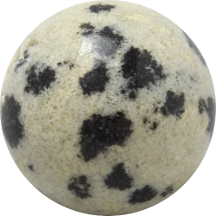
Dalmatian Stone

Dalmatian stone, widely sold as "Dalmatian jasper", is a natural igneous rock, not a jasper. A 2017 Gems & Gemology study identified it as a peralkaline rock (microgranite, aplite or rhyolite) made mostly of feldspar (mesoperthite) and quartz, whose black spots are the alkali amphibole arfvedsonite. The authors recommend the name "dalmatian stone" because the material does not meet the gemological definition of jasper.

Products made with this material

Category
Category
Color
Color

Colors are read from each product’s main photo.

Bead diameter (mm)
Bead diameter (mm)

Only round beads with a verified diameter. A product matches when its stated size range overlaps yours, limits included; a material matches when any of its round sizes does.

Price (USD)
Price (USD)
Availability

Showing 1 of 1 products

Full material guide
Material facts

What the material is, where it comes from or how it is made, identification and care, from the cited sources.

Properties

Nature Natural rock: peralkaline igneous rock (microgranite, aplite or rhyolite); not jasper
Composition Mainly feldspar (mesoperthite) and quartz with arfvedsonite; minor hematite, goethite and epidote-group minerals
Silica content (analysed sample) 73.66 wt.% SiO₂
Color White to grayish matrix with black to greenish spots, usually no more than 4 mm across; surface sometimes stained red to brown by iron oxides
Luster (polished) Waxy

Origins & sources

The rock's source has not been proven. Gemstone dealers name the Mexican state of Chihuahua, which the Gems & Gemology authors consider very probable but still unconfirmed; Mindat records material from Ahumada Municipality, Chihuahua. Peralkaline rocks of this kind are generally abundant in continental rift settings.

Identification

The spots are arfvedsonite, not tourmaline, although they are frequently misidentified as tourmaline. The stone can resemble the Capo Bianco aplite of Elba, Italy, a white rock with black tourmaline nodules. Its composition can be confirmed non-destructively with Raman spectroscopy or SEM-EDS, which also separates it from true jaspers and jasper-like rocks.

Care

Not collected yet

History & culture

History

The name refers to the stone's resemblance to the spotted coat of the Dalmatian dog breed.

Cultural meanings

Not collected yet

Traditional beliefs

Not collected yet

Sources

Collected Oct 23, 2026