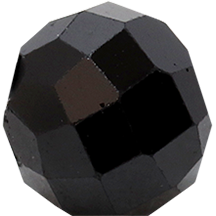
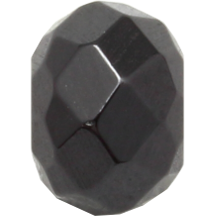
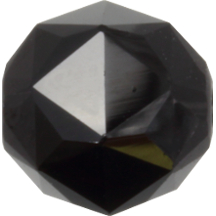
Black Spinel

Black spinel is opaque black spinel, a natural mineral: magnesium aluminium oxide (MgAl₂O₄) with a high iron content that makes it look black. Iron-rich dark spinel has traditionally been called ceylonite or pleonaste. Black spinel from Bo Phloi, Thailand, contains about 20.7 wt% FeO and shows its true greyish-brown colour only in slices much thinner than 0.1 mm.

Products made with this material

Category
Category
Color
Color

Colors are read from each product’s main photo.

Bead diameter (mm)
Bead diameter (mm)

Only round beads with a verified diameter. A product matches when its stated size range overlaps yours, limits included; a material matches when any of its round sizes does.

Price (USD)
Price (USD)
Availability

Showing 3 of 3 products

Full material guide
Material facts

What the material is, where it comes from or how it is made, identification and care, from the cited sources.

Properties

Nature Natural mineral
Mineral species Spinel (iron-rich)
Chemical formula MgAl₂O₄ with substantial Fe²⁺ and Fe³⁺
Color Black (greyish brown in very thin slices)
Crystal system Cubic (isometric)
Refractive index About 1.77 to 1.78 or higher, often over the refractometer limit
Specific gravity About 3.63 to 3.90
Mohs hardness 7.5 to 8
Cleavage None
Magnetism Strongly attracted to a magnet (high iron)

Origins & sources

Spinel forms in metamorphic rocks, especially marbles and limestone contact deposits, and in their weathering products. Black spinel is still abundant at the Bo Phloi gem field in Kanchanaburi Province, western Thailand, once famous for blue sapphire. Many spinels from Sri Lanka are black, and grey to black spinels from Myanmar are occasionally cut as star stones.

Identification

Opaque black spinel has a bright vitreous luster, a refractive index and specific gravity higher than those of ordinary transparent spinel, and strong magnetism from its iron. Several cheaper black stones are sold as black spinel, including black tourmaline (lower luster and refractive index) and darkly irradiated quartz (lower refractive index, translucent at thin edges); black sapphire and black cubic zirconia can also be confused with it. Some transparent dark blue or blue-green spinel is marketed as black spinel. In Thailand the word "nin" now covers various black stones, so it does not guarantee spinel. Synthetic spinel also exists. Natural spinel is seldom treated. Full confirmation of black opaque stones may require laboratory tests such as Raman or FTIR spectroscopy.

Care

With a hardness of 8 and no cleavage, spinel is a durable gem for rings and other jewellery. Ultrasonic and steam cleaners can be used, although fractures could pose a problem; warm soapy water is always a safe alternative. Spinel is stable when exposed to light and chemicals.

History & culture

History

Black spinel was once referred to as ceylonite. At Bo Phloi in Thailand, after corundum production practically ceased, local gem cutters turned to the still-abundant black spinel to make their living and fashion it into various kinds of jewellery.

Cultural meanings

Not collected yet

Traditional beliefs

Not collected yet

Sources

Collected Oct 23, 2026