


Chrysoprase
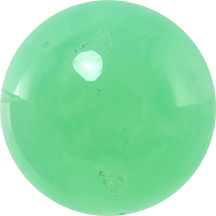
Chrysoprase is a natural, translucent, yellowish-green to green variety of chalcedony (microcrystalline quartz, SiO₂) colored by tiny inclusions of nickel compounds. Its name comes from the Greek for "golden leek" (also rendered "golden apple"). Australia is the leading producer today. It is distinct from dyed green chalcedony and from so-called "lemon chrysoprase", which is a magnesite rock.
Products made with this material
Showing 1 of 1 products
Full material guide
What the material is, where it comes from or how it is made, identification and care, from the cited sources.
Properties
| Mineral species | Quartz (chalcedony variety) |
| Chemical formula | SiO₂ |
| Color | Pale yellowish green to deep green (apple green) |
| Cause of color | Dispersed nickel compounds (nickel-bearing silicate or clay minerals); about 0.2–1.0 wt% NiO in pale stones, up to 5 wt% in deep green |
| Mohs hardness | 6 to 7 |
| Refractive index | About 1.55 |
| Specific gravity | About 2.60 |
| Transparency | Translucent |
| Fracture | Conchoidal |
Origins & sources
Chrysoprase forms at shallow depths where nickel-bearing ultramafic rocks such as peridotite, dunite and serpentinite are deeply weathered, filling cavities, veins and fractures that are usually only a few centimeters wide, so it is mined by the kilogram. The Szklary deposit in Lower Silesia, Poland, was worked intermittently from the Middle Ages until 1980. Australia is now the leading producer, notably Marlborough in Queensland and the Eastern Goldfields of Western Australia (for example Yerilla and Marshall Pool). Near Haneti in central Tanzania, the Iyobo Mountain mine typically yields 7–10 tonnes of mine-run material a year, of which only 3–5% is high quality. Other sources include Kazakhstan, Brazil, Russia and California.
Identification
Much ordinary chalcedony and agate is dyed green to imitate chrysoprase and is often sold incorrectly as "chrysoprase" or "chrysoprase chalcedony"; the correct name is dyed green chalcedony. Dyed material tends to have perfectly even color and clarity and often shows agate banding, which chrysoprase rarely displays; the Chelsea filter (dyed green chalcedony appears pink) and the spectroscope help separate them. Green prase opal looks similar but has a lower refractive index (about 1.45 vs 1.55) and specific gravity (about 2.11 vs 2.60). Green glass and chromium-colored chalcedony (mtorolite) are other look-alikes. "Lemon chrysoprase" is a magnesite rock that is softer (about 4) and heavier (about 3.0) and effervesces in warm acid.
Care
The color of some chrysoprase is unstable: prolonged sunlight or heat can make it fade, so avoid heating the stone during jewelry repair and store it away from direct sunlight and heat sources. Faded chrysoprase has sometimes been recorded to regain its color when stored in very humid conditions.
History
Chrysoprase was known to the ancient Greeks and Romans, though few pieces have been found among their artifacts, and it has been carved into cameos and intaglios since at least the Roman Empire. It first became a popular gem in Europe after deposits in Poland (then German Silesia) were discovered in the 1700s.
Cultural meanings
Not collected yet
Traditional beliefs
Chrysoprase was traditionally associated with curing disorders now linked to uric acid, such as gout and kidney stones. It is also considered one of the stones in the foundation of the Heavenly City described in the Bible, and in some modern birthstone schemes it is regarded as a birthstone for May.
Collected Oct 23, 2026
- Chrysoprase Geology.com (Hobart M. King, PhD, GIA Graduate Gemologist) · Accessed Oct 23, 2026 OverviewPropertiesOrigins & sourcesIdentificationCareHistory
- Chrysoprase and Prase Opal from Haneti, Central Tanzania (Gems & Gemology, Winter 2009) GIA (James E. Shigley, Brendan M. Laurs, Nathan D. Renfro) · Accessed Oct 23, 2026 OverviewPropertiesOrigins & sourcesIdentification
- GemRocks: Chalcedony Central Michigan University (R. V. Dietrich, GemRocks) · Accessed Oct 23, 2026 OverviewPropertiesOrigins & sourcesIdentificationCareHistoryTraditional beliefs
- Chalcedony Value, Price, and Jewelry Information International Gem Society (Joel E. Arem, Ph.D., FGA, et al.) · Accessed Oct 23, 2026 OverviewPropertiesIdentification
- Buying Guide: Get to Know the Different Types of Chalcedony Gem-A (The Gemmological Association of Great Britain; Pat Daly FGA DGA) · Accessed Oct 23, 2026 Identification
- “Lemon ’n’ Lime” Chrysoprase: A Brief Overview of Chrysoprase from Marshall Pool, Western Australia Gemmological Association of Australia, The Australian Gemmologist (Murray Thompson BSc CF FGAA) · Accessed Oct 23, 2026 PropertiesOrigins & sources