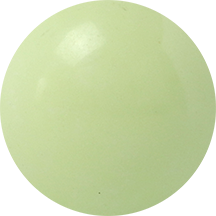
Lemon Chrysoprase

Lemon chrysoprase (also citron chrysoprase) is a misleading trade name: the material is not chrysoprase or any chalcedony but a natural, opaque, pale yellow to lime-green rock composed mainly of nickel-bearing magnesite (magnesium carbonate), often with quartz. Its green color is attributed to nickel, probably as gaspeite (nickel carbonate) in solid solution with the magnesite. Geologists suggest "lemon magnesite" or "citron magnesite" as more accurate names.

Products made with this material

Category
Category
Color
Color

Colors are read from each product’s main photo.

Bead diameter (mm)
Bead diameter (mm)

Only round beads with a verified diameter. A product matches when its stated size range overlaps yours, limits included; a material matches when any of its round sizes does.

Price (USD)
Price (USD)
Availability

Showing 1 of 1 products

Full material guide
Material facts

What the material is, where it comes from or how it is made, identification and care, from the cited sources.

Properties

Material type Rock: nickel-bearing magnesite, often with quartz (not chalcedony)
Composition Mainly MgCO₃ (magnesite) with nickel; magnesite–gaspeite (NiCO₃) solid solution
Color Pale yellow to yellow-green and lime green
Mohs hardness About 4 (magnesite component 3.5 to 5)
Specific gravity About 3.0
Transparency Opaque to semitranslucent

Origins & sources

It forms where serpentine and other ultramafic rocks are weathered or hydrothermally altered, as fracture fillings in peridotite, dunite and serpentinite and as nodules in the soil above them, the same settings as chrysoprase. Most comes from the Eastern Goldfields of Western Australia, in a belt of ultramafic rocks from Norseman to Wiluna, at localities such as Yerilla, Marshall Pool and Goongarrie. It often occurs in the same fractures and nodules as chrysoprase; nodules can have a chrysoprase core with magnesite around it or the reverse.

Identification

GIA's Gems & Gemology described material sold as "lemon chrysoprase" as a quartz–magnesite rock (Johnson and Koivula, 1996); other gemologists found magnesite and quartz together with some chrysoprase (Henn and Milisenda, 1997). Compared with true chrysoprase (hardness about 6–7, SG about 2.60, translucent), it is opaque to semitranslucent, softer (about 4) and heavier (about 3.0), and its magnesite effervesces in warm hydrochloric acid, a destructive test that should be left to a laboratory. Material that mixes green chrysoprase with yellow magnesite occurs too, informally called "lemon 'n' lime" at Marshall Pool.

Care

Not collected yet

History & culture

History

Not collected yet

Cultural meanings

Not collected yet

Traditional beliefs

Not collected yet

Sources

Collected Oct 23, 2026