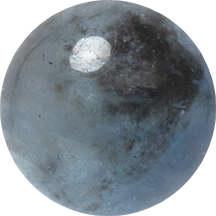
Black Star Aquamarine

Black star aquamarine is a trade name for natural beryl that looks dark brown to black because of dense, oriented inclusions, mainly of the iron-titanium oxide ilmenite, in an otherwise very light blue or pale green aquamarine host. The oriented inclusions give a sheen (schiller) and, in cabochons or beads, can show a six-rayed or even twelve-rayed star. Gemologists usually call it black beryl or star beryl; the dark appearance is linked to the inclusions and the brown colour zones around them, not to the pale aquamarine body colour.

Products made with this material

Category
Category
Color
Color

Colors are read from each product’s main photo.

Bead diameter (mm)
Bead diameter (mm)

Only round beads with a verified diameter. A product matches when its stated size range overlaps yours, limits included; a material matches when any of its round sizes does.

Price (USD)
Price (USD)
Availability

Showing 1 of 1 products

Full material guide
Material facts

What the material is, where it comes from or how it is made, identification and care, from the cited sources.

Properties

Nature Natural mineral with mineral inclusions
Mineral species Beryl (aquamarine host)
Main inclusions Skeletal ilmenite crystals and needles in planes perpendicular to the c-axis
Color Dark brown to black overall; very light blue host
Optical phenomena Schiller (sheen); six- or twelve-rayed asterism
Refractive index About 1.57 (spot reading)
Specific gravity 2.67 to 2.73 (tested beads)
Mohs hardness 7.5 to 8 (beryl)

Origins & sources

Gemological literature describes this type of beryl from Brazil, where oriented ilmenite inclusions in pale green aquamarine from Governador Valadares give a brown body colour and sheen, and from the Conco mine in the Alto Ligonha pegmatite region of Mozambique, sold as "black beryl". Star black beryl beads examined in 2023 had been bought from a Chinese e-commerce platform; their mine origin was not stated.

Identification

Under magnification the material is very light blue aquamarine with black inclusions lying in planes perpendicular to the optic axis, surrounded by brown clouds of colour. In 2023 a gemologist tested star black beryl beads sold as "Devil Blue" aquamarine: spot refractive index 1.57, specific gravity 2.67 to 2.73, inert to UV light and no diagnostic absorption spectrum, with Raman analysis confirming beryl. Three sets of needle-like inclusions perpendicular to the c-axis produce the star; layers of these needles also form parting planes. Because the trade name says "aquamarine" while the stone looks black, testing (refractive index, specific gravity, Raman) is the way to confirm it is beryl rather than another black stone.

Care

Not collected yet

History & culture

History

Brown beryl with oriented ilmenite inclusions from Brazil was described in gemological journals in the mid-1950s, including by John Sinkankas (1955) and W. F. Eppler (1958), who documented a Brazilian brown beryl showing asterism. Mozambican "black beryl" pebbles were offered at the Tucson gem show in 2002, and star black beryl beads appeared in online retail by 2023.

Cultural meanings

Not collected yet

Traditional beliefs

Not collected yet

Sources

Collected Oct 23, 2026