


Goldstone
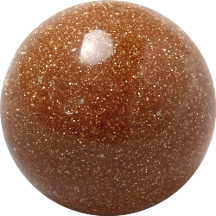
Goldstone is a man-made glass, not a natural stone or mineral. Its glitter comes from tiny flat crystals of metallic copper that grow inside the glass during slow cooling under oxygen-poor conditions. It is also called aventurine glass; it should not be confused with natural aventurine quartz or sunstone, which it is often used to imitate.
Products made with this material
Showing 1 of 1 products
Full material guide
What the material is, where it comes from or how it is made, identification and care, from the cited sources.
Properties
| Nature | Man-made glass |
| Composition | Silicate (soda-lime) glass containing crystals of metallic copper |
| Manufacture | Copper-rich glass melted with reducing agents (iron or tin) and cooled very slowly in a reducing atmosphere so that copper crystals grow |
| Color | Usually reddish brown with copper-colored glitter; also produced in blue, purple and green |
| Structure | Amorphous (glass) |
| Refractive index | 1.530 to 1.550 |
| Specific gravity | 2.50 to 2.80 |
| Mohs hardness | About 6 or slightly less |
Origins & sources
Goldstone is made, not mined. It was developed in the glassworks of Murano, Venice, in the late 16th or early 17th century; the term "pasta venturina" appears in a 1626 Venetian inventory, and the earliest known recipe was recorded by Giovanni Darduin in 1644. A base glass with about 4–6 % cuprous oxide (Cu₂O), plus lead and iron or tin compounds, is melted and then cooled over several days in a reducing atmosphere; the size of the copper crystals, set by this slow cooling, is what distinguishes goldstone from ordinary copper-red glass. In the 1860s French chemists published their own processes, including a green version with chromium oxide crystals.
Identification
Under 20x magnification the copper crystals are easy to see; their uniform shape and size (triangular and hexagonal platelets) and their even distribution through the glass separate goldstone from natural aventurine quartz and sunstone, whose spangles are mineral inclusions of irregular size. Gas bubbles are sometimes visible, as in other glass. In blue, purple and green goldstone the crystals may look silvery rather than coppery. Blue goldstone can resemble lapis lazuli.
Care
Like most glass gems, goldstone is softer than household dust (hardness about 7), so wipe it with a lint-free cloth rather than scrubbing it dry. Mild soap and warm water are safe for untreated, unbacked pieces.
History
The Italian name avventurina is linked to "a ventura", "by chance", because the result was hard to predict: Giovanni Darduin, who recorded the first known recipe, called the process "unpredictable and deceptive". The German term Goldstein, from which "goldstone" derives, appears in 1634. The Miotti family of Murano became the main producers and guarded the recipe for generations; after the family stopped making glass, the formula was divulged in the early 19th century and production in Venice resumed. Popular stories that monks accidentally dropped copper into molten glass are, according to a Mindat article, apocryphal folklore not supported by evidence. Goldstone also gave mineralogy the word "aventurescence".
Cultural meanings
Not collected yet
Traditional beliefs
Not collected yet
Collected Oct 23, 2026
- "Goldstone" - Aventurine Glass Mindat.org (article by Daniel Russell) · Accessed Oct 23, 2026 OverviewPropertiesOrigins & sourcesIdentificationHistory
- Goldstone gemstone information Gemdat.org (Hudson Institute of Mineralogy) · Accessed Oct 23, 2026 OverviewPropertiesIdentification
- Synthetic (Goldstone) and Natural Aventurine - A Review (Glass Europe, vol. 3, 2025) Laurent Cormier, Sorbonne Université (peer-reviewed journal Glass Europe) · Accessed Oct 23, 2026 OverviewPropertiesOrigins & sourcesIdentificationHistory
- Glass Gemstones: Value, Price, and Jewelry Information International Gem Society · Accessed Oct 23, 2026 OverviewCareHistory
- The Adventures of Making Aventurine - Illuminating Objects The Courtauld Institute of Art · Accessed Oct 23, 2026 PropertiesIdentification