Red Jasper
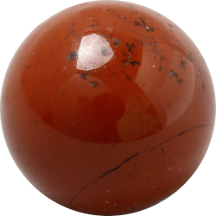
Red jasper is the red to reddish-brown form of jasper, a natural, opaque, impure microcrystalline (cryptocrystalline) quartz, SiO₂, usually grouped with chalcedony or chert. Its red color comes from abundant fine inclusions of hematite and other iron oxides or hydroxides. Mindat notes that red or brown is the historical core meaning of the name jasper.
Products made with this material
Showing 1 of 1 products
Full material guide
What the material is, where it comes from or how it is made, identification and care, from the cited sources.
Properties
| Nature | Natural rock-forming silica: impure microcrystalline quartz (jasper) |
| Chemical formula | SiO₂, with up to about 20% foreign material |
| Color | Red to reddish brown; orange to red is caused by fine inclusions of iron oxides and hydroxides such as hematite |
| Crystal system | Trigonal (quartz), as a microcrystalline aggregate |
| Mohs hardness | 6.5 to 7 |
| Specific gravity | 2.55 to 2.91 |
| Refractive index | 1.540 to 1.553 (often read as about 1.54) |
| Luster | Waxy to dull |
| Transparency | Opaque |
| Cleavage / fracture | No cleavage; conchoidal to splintery or granular fracture |
Origins & sources
Jasper occurs in extensive beds of sedimentary or metamorphic origin, is typically associated with banded iron formations, and also forms cavity fillings, nodules or veins in iron ores and altered igneous rocks; red to brown jasper can also be the petrifying material in fossil wood. Jaspers are found worldwide, with particular colors or patterns tied to particular localities.
Identification
Red jasper is opaque with a waxy to dull luster, unlike translucent agate; its refractive index (about 1.54) and specific gravity (about 2.6) are those of quartz. Jasper is commonly dyed, which can be detected by appearance, absorption spectrum or a Chelsea filter, and heating, which changes its color and is undetectable. Mindat warns that the word jasper is also used informally for many other opaque lapidary materials, including some igneous and sedimentary rocks, so a trade name containing "jasper" does not by itself prove the stone is jasper.
Care
The International Gem Society describes all types of jasper as trouble free to care for and hardy enough for all jewelry uses, with excellent wearability; it takes an excellent polish and is usually cut as cabochons, beads or carvings.
History
The name jasper comes from the Greek for "spotted stone". The International Gem Society notes that the use of jaspers in jewelry goes back into the early history of civilization.
Cultural meanings
Not collected yet
Traditional beliefs
Not collected yet
Collected Oct 23, 2026
- Jasper: Mineral information, data and localities. Mindat.org (Hudson Institute of Mineralogy) · Accessed Oct 23, 2026 OverviewPropertiesOrigins & sourcesIdentification
- Jasper gemstone information Gemdat.org (Mindat) · Accessed Oct 23, 2026 OverviewPropertiesOrigins & sourcesIdentificationHistory
- Jasper Value, Price, and Jewelry Information International Gem Society · Accessed Oct 23, 2026 OverviewPropertiesOrigins & sourcesIdentificationCareHistory
- GemRocks: Jasper Central Michigan University (R. V. Dietrich, GemRocks) · Accessed Oct 23, 2026 PropertiesIdentification
