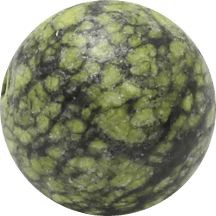
Serpentine

Serpentine is not one mineral but the name for a subgroup of natural magnesium silicate minerals, mainly antigorite, lizardite and chrysotile, which usually occur mixed together as massive rock. The name comes from the snake-like markings of serpentine rock. It is soft, usually green, and is cut into beads, cabochons and carvings. Translucent varieties such as bowenite are often used to imitate jade, but serpentine is not jade.

Products made with this material

Category
Category
Color
Color

Colors are read from each product’s main photo.

Bead diameter (mm)
Bead diameter (mm)

Only round beads with a verified diameter. A product matches when its stated size range overlaps yours, limits included; a material matches when any of its round sizes does.

Price (USD)
Price (USD)
Availability

Showing 1 of 1 products

Full material guide
Material facts

What the material is, where it comes from or how it is made, identification and care, from the cited sources.

Properties

Nature Natural mineral group, usually as massive rock
Mineral group Serpentine subgroup (kaolinite-serpentine group): antigorite (incl. bowenite, williamsite), lizardite, chrysotile
Chemical formula Mg₃Si₂O₅(OH)₄ (nickel may be present)
Color Shades of green, yellowish green, brownish green, white, bluish white to bluish green, brownish red; sometimes banded
Mohs hardness About 2.5 to 3.5; williamsite 4.5; bowenite 4 to 6
Refractive index 1.532 to 1.571, depending on the member
Specific gravity 2.44 to 2.77 (gem range); bowenite 2.58 to 2.62
Luster Resinous, greasy, waxy, pearly or earthy
Transparency Translucent to opaque

Origins & sources

Serpentine forms when basic and ultrabasic rocks are altered. Antigorite occurs on every continent, and lizardite is the most common serpentine overall. Notable bowenite sources include Afghanistan, China (light yellowish green), New Zealand, the Transvaal in South Africa (banded green) and the eastern United States; williamsite is best known from Rock Springs, Maryland, and lizardite from the Lizard Peninsula in Cornwall, England. Rocks that mix serpentine with carbonates include verd antique and Ireland's Connemara marble.

Identification

Serpentine is often sold as a jade simulant, sometimes under misleading names such as "Korean jade"; "Styrian jade" is also a serpentine. Jadeite and nephrite have higher specific gravity and refractive index and are far tougher, so gemologists can usually tell them apart easily. Serpentine may be resin-impregnated for stability or dyed, either green to look more like jade or in colors outside its natural range such as orange and purple. Its low hardness means it scratches easily.

Care

All serpentines are soft enough to be scratched by household dust, so they suit earrings, pendants and brooches better than rings, which need protective settings. Do not use steam or ultrasonic cleaners; clean only with a soft brush, mild detergent and warm water. Chrysotile is asbestos: finished, non-fibrous pieces are safe to wear, but cutting it releases hazardous dust.

History & culture

History

Serpentine has long been carved: the Taíno of the Caribbean made zemí figures, objects that housed an ancestral spirit, from serpentine rock, and the Māori carved heirloom hei-tiki pendants from a clear form of bowenite known as tangiwai pounamu. Bowenite is named after G. T. Bowen, who studied Rhode Island material but misidentified it as nephrite. Serpentine is the state rock of California, and bowenite is the state mineral of Rhode Island.

Cultural meanings

Not collected yet

Traditional beliefs

Not collected yet

Sources

Collected Oct 23, 2026