Sado Red Jasper
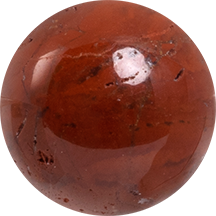
Sado red jasper, called akadama-ishi (赤玉石) in Japan, is a natural red jasper from the Akadama district on the southeastern coast of Sado Island, Niigata Prefecture. Sado City describes it as a very hard aggregate of tiny quartz crystals, also called ferruginous quartz (鉄石英), whose red color comes from hematite. The Sado Geopark counts it among Japan's three great named stones (日本三大銘石).
Products made with this material
Showing 1 of 1 products
Full material guide
What the material is, where it comes from or how it is made, identification and care, from the cited sources.
Properties
| Nature | Natural red jasper: aggregate of tiny quartz crystals |
| Composition | Microcrystalline quartz (SiO₂); red parts contain hematite, yellow parts limonite, bluish parts clay minerals |
| Color | Red, sometimes with yellow |
| Hardness | Very hard (quartz aggregate); no numeric value given by the source |
| Locality | Akadama, Sado City, Niigata Prefecture, Japan |
Origins & sources
Sado City explains that akadama-ishi is thought to have formed with the volcanic activity that created Sado's gold and silver veins, although exactly how it formed is still unclear; it occurs as veins in igneous rock. Earth-science researcher Takashi Ishibashi notes that it occurs in andesite and is found as pebbles on the coast and in rivers; it was once mined around Sugiike pond, but production has ceased, so good material is scarce. The Sado Geopark links the stone to the landslide-prone steep southern slope of the Kosado mountains, and in the great flood of 1897 (Meiji 30) many akadama stones were exposed from the ground.
Identification
Akadama-ishi is a quartz-crystal aggregate, which distinguishes it from the similar-looking local "akaishi" (赤石), a red chert; Sado City's geopark leaflet makes exactly this distinction. Its red, yellow and bluish tones correspond to hematite, limonite and clay-mineral content. Origin from Sado cannot be confirmed from appearance alone.
Care
Not collected yet
History
According to Sado City, akadama-ishi was used on Sado for arrowheads from the Jōmon period, and in the Yayoi period, when bead making flourished, it was made into tubular beads (kudatama) that have been excavated. Ishibashi adds that it is said to have been presented to Toyotomi Hideyoshi and that from the Edo period it was prized and set in gardens around Japan. In the early Edo period the Sado magistrate presented akadama stones to Edo Castle. After the 1897 flood, the money from selling the exposed stones (about 5,000 yen) was distributed to every household of Akadama village under the village rules, helping its recovery.
Cultural meanings
Not collected yet
Traditional beliefs
In Japan, akadama-ishi is regarded as a meiseki (銘石, named stone) and, according to the Sado Geopark, is counted as one of Japan's three great named stones.
Collected Oct 23, 2026
- ジオパーク市民講座中級コース資料(赤玉石 ~集落を救った石~) Sado City (佐渡市) · Accessed Oct 23, 2026 OverviewPropertiesOrigins & sourcesIdentificationHistory
- 赤玉の地すべり地形と赤玉石 Sado Island Geopark Promotion Council (佐渡ジオパーク推進協議会) · Accessed Oct 23, 2026 OverviewPropertiesOrigins & sourcesTraditional beliefs
- いしばし先生に聞く「日本の宝石鉱物」vol.04(レッドジャスパー “赤玉石”) differencee (column by Takashi Ishibashi, former chief researcher, Masutomi Geological Museum) · Accessed Oct 23, 2026 OverviewPropertiesOrigins & sourcesHistory
