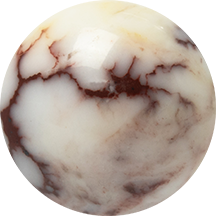
White Buffalo Stone

White Buffalo is a trade name for a white stone with black to brown matrix from Nevada, USA, often sold as "White Buffalo Turquoise" or "white turquoise". It is not turquoise: tested samples contained no copper or phosphate and proved to be natural carbonate rock, identified as magnesite with dolomite by Geology.com's X-ray diffraction and as aragonite with dolomite in independent infrared tests. Because the composition is not fixed, Geology.com recommends the name "White Buffalo Stone".

Products made with this material

Category
Category
Color
Color

Colors are read from each product’s main photo.

Bead diameter (mm)
Bead diameter (mm)

Only round beads with a verified diameter. A product matches when its stated size range overlaps yours, limits included; a material matches when any of its round sizes does.

Price (USD)
Price (USD)
Availability

Showing 1 of 1 products

Full material guide
Material facts

What the material is, where it comes from or how it is made, identification and care, from the cited sources.

Properties

Nature Natural rock (carbonate); trade name, not turquoise
Composition (tested samples) Magnesite with dolomite (XRD, Geology.com); aragonite with dolomite (infrared, D. Kasper); no copper or phosphate detected
Color White, often with black matrix (tested Nevada material); Pascle describes white with brown mottling

Origins & sources

The material is mined in Nevada; the White Buffalo claims of the Otteson family, associated with Tonopah, are recorded by the Bureau of Land Management in the Battle Mountain district, Esmeralda County. The Japanese retailer Pascle also lists Arizona and defines its own White Buffalo as the nearly hematite-free white part of "Wild Horse", a different usage of the name.

Identification

Genuine turquoise is a copper phosphate, and its copper should prevent a snow-white color, so a white stone sold as "white turquoise" or "White Buffalo Turquoise" is better treated as White Buffalo Stone. Over the years the material has been variously reported as calcite, calcite with opal, howlite, magnesite and planerite; only laboratory methods such as X-ray diffraction or infrared spectroscopy establish what a given piece is.

Care

Not collected yet

History & culture

History

Not collected yet

Cultural meanings

Not collected yet

Traditional beliefs

Not collected yet

Sources

Collected Oct 23, 2026