


Pink Calcite
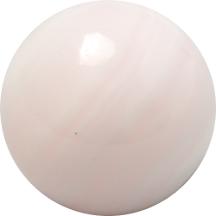
Pink calcite is a descriptive name for natural calcite (calcium carbonate, CaCO₃) with a pink colour; it is a colour variety, not a separate mineral species. In studied samples the pink colour is linked mainly to manganese replacing calcium (manganese-bearing, or manganoan, calcite). Cobalt-bearing calcite, which ranges from pink to purplish red, is another type.
Products made with this material
Showing 1 of 1 products
Full material guide
What the material is, where it comes from or how it is made, identification and care, from the cited sources.
Properties
| Material type | Natural mineral (colour variety of calcite) |
| Mineral species | Calcite |
| Chemical formula | CaCO₃ |
| Color | Pale to deep pink; cobalt-bearing material pink to purplish red |
| Cause of color | Mainly manganese (Mn²⁺/Mn³⁺ absorption) in studied samples; cobalt (Co²⁺) in cobalt-bearing calcite |
| Crystal system | Trigonal |
| Mohs hardness | 3 |
| Specific gravity | 2.71 (pure) to 2.94 |
| Refractive index | 1.486 to 1.658 |
| Birefringence | 0.172 to 0.190 |
| Cleavage | Perfect rhombohedral, in three directions |
| Luster | Vitreous to pearly |
| Possible treatments | Dyeing, wax or plastic impregnation, irradiation |
Origins & sources
Calcite occurs in most geological settings and is most common as massive material in limestone and marble; it also forms in hydrothermal deposits. Pink manganese-rich calcite studied in 2026 came from the Xilingol mining area in Inner Mongolia, China. Mindat records manganese-bearing calcite as originally reported from Banská Štiavnica, Slovakia. Cobalt-bearing pink to purplish-red calcite has been documented from Spain and Switzerland.
Identification
Like all calcite, it has a Mohs hardness of 3, three directions of perfect rhombohedral cleavage and very strong birefringence (about 0.172), and it fizzes readily in acids, even weak ones such as vinegar. Mindat places calcite in a series with rhodochrosite (MnCO₃), which is the basis for the link that the Japanese retailer Pascle draws between pink calcite and rhodochrosite ("Inca Rose"). Manganese-rich pink calcite from Inner Mongolia showed stable orange-red fluorescence near 625 nm under long-wave UV. Dark pink cobalt-bearing calcite is easily confused with spherocobaltite (CoCO₃). Pascle notes that most pink calcite beads are a pale, almost white pink. Calcite may be dyed, impregnated with wax or plastic, or irradiated, so a strong colour in inexpensive beads is not by itself proof of natural colour.
Care
Calcite (Mohs 3) scratches easily and splits readily along its cleavage. A care table based on GIA's Gem Reference Guide advises never using ultrasonic or steam cleaners; warm soapy water is usually safe. Keep it away from acids, which make it effervesce, and from high heat, at which it can crack apart (decrepitate). The same table lists natural calcite colours as stable to light.
History
The mineral name calcite comes from the Latin calx, "lime". Mindat describes it as an ancient name and credits Pliny the Elder (AD 79) with naming it as a mineral. Colour names such as this one are descriptive trade names, not separate mineral names.
Cultural meanings
The Japanese retailer Pascle writes that stones of the calcite group are said to settle unstable emotions and smooth relationships with other people, and recommends pink calcite as a charm for communication.
Traditional beliefs
Not collected yet
Collected Oct 23, 2026
- Calcite: Mineral information, data and localities. Mindat.org · Accessed Oct 23, 2026 OverviewPropertiesOrigins & sourcesIdentificationHistory
- Calcite Value, Price, and Jewelry Information International Gem Society · Accessed Oct 23, 2026 PropertiesOrigins & sourcesIdentification
- Mineralogical Characteristics and Fluorescent Properties of Yellow and Pink Calcite (Yan, Liang & Guo, Crystals 16(5), 2026) MDPI Crystals · Accessed Oct 23, 2026 OverviewPropertiesOrigins & sourcesIdentification
- Gemsdat: Calcite (compiled gemological test records) Gemsdat · Accessed Oct 23, 2026 Origins & sources
- Calcite - Antique Jewelry University (gemological and care table citing GIA Gem Reference Guide, 1988) Lang Antiques · Accessed Oct 23, 2026 PropertiesIdentificationCare
- Pascle stone page: pink_calcite (retailer claims) Pascle (Japanese retailer) · Accessed Oct 23, 2026 IdentificationCultural meanings