


Golden Obsidian
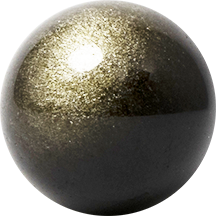
Golden obsidian is natural obsidian, a volcanic glass, that shows a golden sheen; it is a form of sheen obsidian. The sheen comes from light reflecting off minute inclusions, mainly tiny gas bubbles stretched flat along the flow layers of the glass. It is untreated natural material, not a mineral and not man-made.
Products made with this material
Showing 1 of 1 products
Full material guide
What the material is, where it comes from or how it is made, identification and care, from the cited sources.
Properties
| Nature | Natural volcanic glass (a rock, not a mineral) |
| Parent material | Obsidian |
| Composition | Silica-rich glass: about 66–72% SiO₂ plus oxides of calcium, sodium, potassium and others |
| Structure | Amorphous (isotropic) |
| Mohs hardness | 5 to 5.5 |
| Refractive index | 1.48 to 1.51 (usually 1.49) |
| Specific gravity | Typically 2.33 to 2.42 |
| Fracture | Conchoidal, with very sharp edges; no cleavage |
| Luster | Vitreous |
| Color | Black or dark glass with a golden sheen |
| Optical effect | Sheen from flattened gas bubbles and other minute inclusions |
Origins & sources
Like all obsidian, it forms when silica-rich lava cools too quickly for crystals to grow. Mexico yields an abundance of sheen obsidian, and gold sheen obsidian is also found at Glass Buttes in central Oregon, USA.
Identification
The golden sheen comes from inclusions inside the glass; the flattened bubbles that cause it can often be seen with a strong magnifying glass. Natural obsidian may contain crystallites, straight banding or needles, and it can react moderately to very strongly to a magnet; these features help separate it from artificial glass, although none is a definitive test. Jet, chalcedony and black tourmaline (schorl) can look similar, and a refractive index test separates them. Brightly colored or water-clear "obsidian" is often man-made glass.
Care
Obsidian is brittle and chips or breaks easily on impact, and with a hardness of about 5 to 5.5 it scratches easily, so it suits earrings, pendants and brooches better than rings or bracelets. Household dust (hardness about 7) is harder than obsidian, so wipe it with a lint-free cloth instead of scrubbing it dry. Inclusions can expand when heated, so avoid mechanical cleaning systems and use mild soap, a soft brush and warm water.
History
Obsidian in general has been worked since the Stone Age: it breaks with a conchoidal fracture into very sharp edges, so it was made into knives, arrowheads, spear points and scrapers and was traded over distances of up to about a thousand miles. Ancient people also polished it into mirrors. According to the Roman naturalist Pliny the Elder, the name comes from Obsius, who found such a stone in Ethiopia.
Cultural meanings
Not collected yet
Traditional beliefs
Not collected yet
Collected Oct 23, 2026
- Obsidian: Igneous Rock - Pictures, Definition, Formation Geology.com (Hobart M. King, PhD) · Accessed Oct 23, 2026 OverviewPropertiesOrigins & sourcesCareHistory
- Obsidian Value, Price, and Jewelry Information International Gem Society (Joel E. Arem, Ph.D., FGA) · Accessed Oct 23, 2026 OverviewPropertiesOrigins & sourcesIdentificationCareHistory
- Sheen Obsidian: Mineral information, data and localities Mindat.org (Hudson Institute of Mineralogy) · Accessed Oct 23, 2026 OverviewProperties
- Obsidian: Mineral information, data and localities Mindat.org (Hudson Institute of Mineralogy) · Accessed Oct 23, 2026 OverviewProperties
- Obsidian gemstone information Gemdat.org (Hudson Institute of Mineralogy) · Accessed Oct 23, 2026 PropertiesIdentification
- Obsidian Volcano World, Oregon State University · Accessed Oct 23, 2026 OverviewPropertiesOrigins & sourcesIdentification