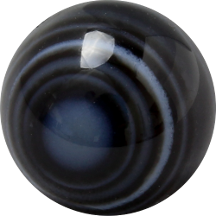
Eye Agate

Eye agate is agate (banded chalcedony, a microcrystalline form of quartz, SiO₂) with a concentric ring pattern that looks like an eye; Mindat lists it as a variety of agate. In the Japanese bead trade the name 天眼石 (tengan-seki) usually means black agate with white eye-like bands, and this black color is commonly produced by dye: a laboratory report published by the retailer Pascle identified its sample as natural polycrystalline quartz (black onyx) colored with dye.

Products made with this material

Category
Category
Color
Color

Colors are read from each product’s main photo.

Bead diameter (mm)
Bead diameter (mm)

Only round beads with a verified diameter. A product matches when its stated size range overlaps yours, limits included; a material matches when any of its round sizes does.

Price (USD)
Price (USD)
Availability

Showing 1 of 1 products

Full material guide
Material facts

What the material is, where it comes from or how it is made, identification and care, from the cited sources.

Properties

Material type Natural agate (banded chalcedony, variety of quartz); trade beads usually dyed
Chemical formula SiO₂
Pattern Concentric rings resembling an eye
Treatment Dyeing is common; the tested Japanese trade sample (black with white bands) was colored by dye
Mohs hardness 6.5 to 7 (agate)
Specific gravity 2.60 to 2.64 (agate)
Refractive index 1.530 to 1.543 (agate)

Origins & sources

Not collected yet

Identification

Eye agate is defined by its pattern, not by a separate mineral: Mindat describes agate with concentric rings that look like an eye, lists "Aleppo stone" as a synonym and "bird's eye agate" as a sub-type, and gives the German names Augenachat and Augenstein. For the black-and-white 天眼石 beads sold in Japan, the report published by Pascle (laboratory: 日本彩珠宝石研究所) reads: natural quartz (polycrystalline), gem name black onyx, black opaque stone with white bands, colored by dye. The IGS notes that black onyx sold in stores is almost always dyed and that dyeing of chalcedony is common, usually stable, and should be disclosed.

Care

As chalcedony, eye agate needs no special care; clean it with mild detergent, warm water and a soft brush. Dyeing of agate is usually stable.

History & culture

History

Not collected yet

Cultural meanings

Not collected yet

Traditional beliefs

According to Japanese retailers such as Pascle, the name 天眼石 refers to its eye-like pattern; they say it was first found in Tibet lying on the ground rather than buried, was therefore said to have fallen from heaven, and was long used for ritual objects and amulets, and they associate it with warding off evil. These are trade claims that independent sources read for this record do not document.

Sources

Collected Oct 23, 2026