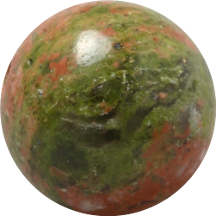
Unakite

Unakite is a natural rock, not a single mineral: an altered granite made chiefly of pink orthoclase feldspar, green epidote and white to smoky quartz. The epidote formed secondarily, replacing the mica or hornblende of the original granitic rock. It takes a high polish and is used as an ornamental stone.

Products made with this material

Category
Category
Color
Color

Colors are read from each product’s main photo.

Bead diameter (mm)
Bead diameter (mm)

Only round beads with a verified diameter. A product matches when its stated size range overlaps yours, limits included; a material matches when any of its round sizes does.

Price (USD)
Price (USD)
Availability

Showing 1 of 1 products

Full material guide
Material facts

What the material is, where it comes from or how it is made, identification and care, from the cited sources.

Properties

Nature Natural rock (altered granitoid)
Main minerals Epidote (green, variable, sometimes over half the rock), pink orthoclase feldspar (about one quarter to one third) and quartz (about one quarter); minor magnetite, zircon and apatite
Specific gravity 2.79 (measured on the original material, 1874)
Color Mottled pink (feldspar) and green (epidote), with gray to smoky quartz

Origins & sources

Unakite forms by hydrothermal alteration of granitic rocks. It was first described from the Unaka range of the Great Smoky Mountains on the North Carolina–Tennessee border (Cocke County, Tennessee, and Madison County, North Carolina) and also occurs in the Blue Ridge of Virginia, for example at Milams Gap near Luray. It has also been described from Finland and India.

Identification

Unakite is recognized by its combination of old-rose pink feldspar and green epidote, with clear to smoky quartz between them; proportions vary from mostly feldspar to quartz-epidote rock (epidosite). The rose-colored feldspar can bleach to white on long outdoor exposure.

Care

Not collected yet

History & culture

History

The name unakite was proposed in 1874 by F. H. Bradley for the Unaka range, where he found it; he expected the compact, highly polishable rock to become a valuable ornamental stone. In 1904 W. C. Phalen of the U.S. National Museum (Smithsonian) described a second American occurrence at Milams Gap, Virginia.

Cultural meanings

Not collected yet

Traditional beliefs

Not collected yet

Sources

Collected Oct 23, 2026