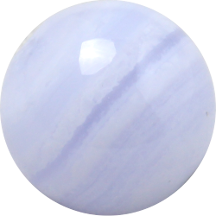
Blue Lace Agate

Blue lace agate is a natural variety of agate (banded chalcedony, a microcrystalline form of quartz, SiO₂) with pale blue and white, lace-like banding. For several decades its primary source was a single mine in southern Namibia, the Ysterputs Mine, which operated from 1962 until January 2017; similar material is known from a few other places.

Products made with this material

Category
Category
Color
Color

Colors are read from each product’s main photo.

Bead diameter (mm)
Bead diameter (mm)

Only round beads with a verified diameter. A product matches when its stated size range overlaps yours, limits included; a material matches when any of its round sizes does.

Price (USD)
Price (USD)
Availability

Showing 1 of 1 products

Full material guide
Material facts

What the material is, where it comes from or how it is made, identification and care, from the cited sources.

Properties

Material type Natural agate (banded chalcedony), a variety of quartz
Chemical formula SiO₂
Color Pale blue with white, wavy lace-like bands
Crystal system Trigonal (cryptocrystalline quartz)
Mohs hardness 6.5 to 7
Specific gravity About 2.6
Refractive index 1.530 to 1.543
Luster Waxy; vitreous when polished

Origins & sources

Blue lace agate is a vein agate. At the Ysterputs Mine on Ysterputs Farm 254 (Karasburg West, ǁKaras Region, Namibia) it formed as hydrothermal veins, typically 20–30 mm thick, in a Jurassic dolerite sill, where silica-rich, saline fluids filled fractures and deposited the agate in successive bands. The mine operated from 1962 until January 2017. Mindat also records blue lace agate from the Lapurr Range in Turkana County, Kenya, and similar vein material has been described from Malawi.

Identification

Its lace pattern consists mainly of blue, spherulitic chalcedony bands layered with bands of white, micro-granular quartz; pieces often have a central area of unbanded chalcedony or a cavity lined with clear or blue druzy quartz, sometimes with calcite. The blue color is attributed to Rayleigh scattering of light by tiny inclusions or cavities, not to a pigment. Agate is porous and readily accepts dye, and most strongly colored agates in the trade are dyed; vivid blue banded beads should therefore be checked for dye. The IGS notes that dyed blue chalcedony appears pink under a Chelsea filter.

Care

Like other chalcedony, blue lace agate needs no special care; clean it with mild detergent, warm water and a soft brush.

History & culture

History

According to the website of the Namibian blue lace agate operation, George Swanson located the Ysterputs deposit in about 1962; his company mined it by hand and, from 1977, mechanically, and shipped the rough via Springbok, South Africa, mainly to the East for spheres, beads and cabochons. The same source says that after the 1972 Apollo 17 "Blue Marble" photograph of Earth, Swanson marketed blue lace spheres in the United States on their resemblance to it.

Cultural meanings

Not collected yet

Traditional beliefs

Not collected yet

Sources

Collected Oct 23, 2026