


Moonstone
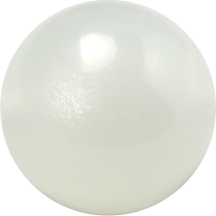
Moonstone is a variety of the feldspar-group mineral orthoclase. As it forms, orthoclase and albite separate into thin alternating layers; light scattered between these layers produces adularescence, a soft glow that seems to billow across the stone. Hecatolite is a recorded synonym.
Products made with this material
Showing 1 of 6 products
Full material guide
What the material is, where it comes from or how it is made, identification and care, from the cited sources.
Properties
| Mineral species | Orthoclase (feldspar group), intergrown with albite |
| Chemical formula | KAlSi₃O₈ |
| Color | Colorless to white, gray, green, peach, brown |
| Refractive index | 1.518 to 1.526 |
| Specific gravity | 2.58 |
| Mohs hardness | 6 to 6.5 |
| Toughness | Poor; two cleavage directions |
Origins & sources
The most important sources are India and Sri Lanka. Moonstone also comes from Brazil, Madagascar, Myanmar and Tanzania, and in the United States from New Mexico, North Carolina and Virginia. Mt. Adular in Switzerland (now St. Gotthard) was one of the first sources of fine-quality moonstone.
Identification
The key feature is adularescence: a misty light that appears to roll across the surface as the viewing angle changes. The finest moonstone is transparent and colorless with a mobile blue sheen; some stones also show a cat's-eye effect, and tiny tension cracks called "centipedes" are characteristic inclusions. It is usually cut as a cabochon to show the effect.
Other feldspars can also show adularescence, including sanidine and labradorite. A labradorite from Madagascar with multicolored sheen over a light body color is sold as "rainbow moonstone", although GIA notes it is labradorite rather than orthoclase. Mindat uses "moonstone" more broadly as a trade name for white feldspars with a blue schiller, so trade labels alone do not establish the mineral species.
Care
Moonstone (Mohs 6 to 6.5) has poor toughness and two cleavage directions, so a hard blow can break it; it is often set in pendants, earrings and pins rather than rings. High heat or sudden temperature changes can cause breaks. It is stable to light but is harmed by hydrofluoric acid. Clean only with warm, soapy water and a soft brush; never use ultrasonic or steam cleaners.
History
Adularescent moonstone was once called "adularia", after Mt. Adular in Switzerland. Great designers of the Art Nouveau era (1890s–1910s), such as René Lalique and Louis Comfort Tiffany, featured moonstone in their jewelry, and it was a favorite of Arts and Crafts artisans in the late nineteenth century for handcrafted silver. It returned to prominence with the 1960s "flower child" movement and with New Age designers of the 1990s.
Cultural meanings
Moonstone is one of the June birthstones, together with pearl and alexandrite. It has been associated with both the Roman and Greek lunar deities, and it is often associated with love, passion and fertility.
Traditional beliefs
According to Hindu mythology, moonstone is made of solidified moonbeams, and many other cultures have also linked it with moonlight. Legends say it brings good luck, and many people once believed that holding a moonstone in the mouth during a full moon would let them see the future. These are traditional beliefs, not established properties.
Collected Oct 22, 2026
- What Is Moonstone Gemstone | Moonstone Stone – GIA GIA (Gemological Institute of America) · Accessed Oct 22, 2026 OverviewPropertiesIdentificationCultural meanings
- Moonstone Description GIA (Gemological Institute of America) · Accessed Oct 22, 2026 OverviewPropertiesIdentification
- Moonstone History and Lore GIA (Gemological Institute of America) · Accessed Oct 22, 2026 Origins & sourcesHistoryTraditional beliefs
- June Birthstones | Pearl, Alexandrite, Moonstone Birthstones | GIA GIA (Gemological Institute of America) · Accessed Oct 22, 2026 Origins & sourcesCareHistoryCultural meaningsTraditional beliefs
- Moonstone Care and Cleaning Guide GIA (Gemological Institute of America) · Accessed Oct 22, 2026 PropertiesCare
- Moonstone: Mineral information, data and localities. Mindat.org (Hudson Institute of Mineralogy) · Accessed Oct 22, 2026 OverviewIdentification