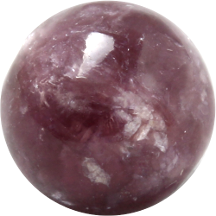
Lepidolite

Lepidolite is a natural lithium-rich mica, usually pink, red or purple. It is not a single IMA mineral species: Mindat describes it as a field name for the Li-rich micas in or near the polylithionite–trilithionite series (also fluorluanshiweiite and luanshiweiite). Its color comes mainly from manganese, not lithium, and gem material is often lepidolite impregnated with quartz.

Products made with this material

Category
Category
Color
Color

Colors are read from each product’s main photo.

Bead diameter (mm)
Bead diameter (mm)

Only round beads with a verified diameter. A product matches when its stated size range overlaps yours, limits included; a material matches when any of its round sizes does.

Price (USD)
Price (USD)
Availability

Showing 1 of 1 products

Full material guide
Material facts

What the material is, where it comes from or how it is made, identification and care, from the cited sources.

Properties

Nature Natural mineral (field name for a range of Li micas, not one species)
Mineral group Mica group (trioctahedral micas); polylithionite–trilithionite series
Chemical formula From polylithionite KLi₂Al(Si₄O₁₀)(F,OH)₂ to trilithionite K(Li₁.₅Al₁.₅)(AlSi₃O₁₀)(F,OH)₂
Color Usually pink, red or purple, often grayish; rarely colorless or yellow
Cause of color Manganese
Crystal system Monoclinic
Mohs hardness 2.5 to 4
Specific gravity 2.8 to 3.3
Refractive index 1.525 to 1.587
Birefringence 0.018 to 0.038
Cleavage Perfect and easy in one direction
Luster Pearly on cleavage; also sub-vitreous to greasy

Origins & sources

Lepidolite forms only where lithium is highly concentrated, mainly in late-stage granite pegmatites, greisens and tin-bearing veins, together with minerals such as elbaite tourmaline, spodumene, quartz and feldspars. Notable occurrences include Minas Gerais (Brazil), Manitoba (Canada), Honshu (Japan), Madagascar, the Ural Mountains (Russia), Sweden, Zimbabwe and California, Maine and New Mexico (USA). The original lepidolite came from the Rožná pegmatite in the Czech Republic.

Identification

A pink to purple mica with perfect one-direction cleavage and pearly luster is probably lepidolite, but the name is sometimes wrongly applied to lithian muscovite, which can have the same pink to purple color. Because lepidolite alone is too soft and cleavable for jewelry, beads and cabochons are usually lepidolite impregnated with quartz and sold simply as "lepidolite"; small lepidolite flakes also color some pink, red and purple aventurine quartz. Faceted lepidolite is very rare.

Care

Not collected yet

History & culture

History

Lepidolite was named in 1792 by Martin Klaproth from the Greek lepidos ("scale") and lithos ("stone"), for the scaly look of the massive material. In the first half of the 1900s it was an important minor ore of lithium, sometimes with rubidium and cesium as byproducts.

Cultural meanings

Not collected yet

Traditional beliefs

Not collected yet

Sources

Collected Oct 23, 2026