


Nachiguro Stone
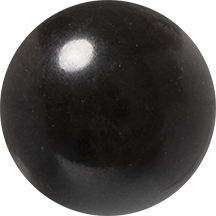
Nachiguro stone (Nachiguro-ishi) is a natural sedimentary rock: a jet-black, fine-grained and exceptionally dense black shale (siliceous shale, sometimes called slate) from the Kumano Group, quarried only around Kamikawa-cho in Kumano City, Mie Prefecture. It is the stone used for natural-stone black go stones in Japan and is also made into inkstones, touchstones and ornaments. Despite its name, it is not produced at Nachi in Wakayama Prefecture.
Products made with this material
Showing 1 of 1 products
Full material guide
What the material is, where it comes from or how it is made, identification and care, from the cited sources.
Properties
| Nature | Natural rock (sedimentary) |
| Rock type | Black shale; also described as black siliceous shale (slate) |
| Geological unit | Onuma Formation, Kumano Group (marine strata) |
| Age | Early Miocene, Neogene (about 15 million years, per the Mie Prefectural Museum) |
| Main minerals | Fine clastic grains with a moderate amount of graphite and traces of quartz and plagioclase, in a strongly clay-altered matrix; scattered fine black organic particles |
| Composition | XRF analysis by the Geological Survey of Japan: SiO₂ 64.78%, Al₂O₃ 17.09%, FeO 4.24%, K₂O 3.17% |
| Color | Jet black, opaque; gains a deeper black luster the more it is polished |
Origins & sources
Nachiguro stone occurs in a belt about 4 km long east–west, from the Kōnoue settlement to Ōkawara in Kamikawa-cho, Kumano City, where it is quarried from the Onuma Formation of the Kumano Group, marine strata deposited on the continental shelf and slope. In 1999 three quarries at Kōnoue cut the stone by bench excavation; only the massive lower part of the face is usable, because the upper part has fine slaty cleavage. Black pebbles of the same stone were once also gathered on the Shichiri-mihama beach and used as garden stones.
Identification
Because its clastic grains are aligned roughly parallel to the bedding, the stone has a weak cleavage and splits cleanly into plates; it is unusually dense for a Neogene mudstone and polishes to a jet-black luster. It has long been used as a touchstone for testing the purity of gold. Many ornaments, figurines and vases are not carved stone but powder-moulded products made from Nachiguro stone powder (made since about 1970), and black go stones are also made of glass and plastic.
Care
Kumano City advises that Nachiguro stone gains luster the more carefully it is polished: first rub the edges and whole surface with a coarse whetstone, then wet-sand with #150, #320 and #600 sandpaper in turn, and finish with commercial wax, brushing it in and buffing with a cloth.
History
The name Nachiguro first appears in the Kii Zoku Fudoki compiled in 1839, and Ihara Saikaku's 1686 novel mentions Nachi stone scattered in a miniature landscape. The 1795 inkstone catalogue Wakan Kenpu lists a black inkstone stone from Kishu Kumano, and the Kishu domain valued the inkstones of Kōnoue village before banning quarrying for a time. After the ban was lifted in the Meiji era, Yamanishi Tokunosuke of Kōnoue began selling inkstones; the stone came into wide use for black go stones from about 1887. The producers' cooperative suggests the name arose because it was sold as a souvenir of pilgrimages to Nachi, though Kumano City notes the origin is uncertain. The local cooperative registered Nachiguro-ishi as a regional collective trademark in 2020, and it is a Mie Prefecture designated traditional craft.
Cultural meanings
Not collected yet
Traditional beliefs
It is said, without firm evidence, that the go stones (kishi) among the gifts carried to China by Japanese envoys to the Tang dynasty may have been Nachiguro stone; Kumano City and the producers' cooperative present this only as a tradition.
Collected Oct 23, 2026
- 三重県総合博物館 那智黒石 Mie Prefectural Museum (MieMu) · Accessed Oct 23, 2026 OverviewPropertiesOrigins & sourcesIdentification
- 近畿の石材(切石)-那智黒石-(地質ニュース609号) Geological Survey of Japan (AIST) · Accessed Oct 23, 2026 OverviewPropertiesOrigins & sourcesIdentificationHistory
- 那智黒石|熊野自慢の特産品・物産 Kumano City · Accessed Oct 23, 2026 OverviewPropertiesIdentificationCareHistoryTraditional beliefs
- 那智黒石とは Kumano Nachiguro-ishi Cooperative (producers' association) · Accessed Oct 23, 2026 OverviewPropertiesOrigins & sourcesIdentificationHistoryTraditional beliefs