


Crackle Quartz
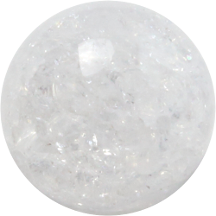
Crackle quartz is treated natural quartz, not a separate mineral: the quartz is heated and then plunged into water, and the thermal shock fills it with a network of fine internal fractures ("quench crackling"). The fractures can show iridescent colors and also let dye enter, so crackled quartz is often dyed, sometimes to imitate more valuable gems.
Products made with this material
Showing 1 of 1 products
Full material guide
What the material is, where it comes from or how it is made, identification and care, from the cited sources.
Properties
| Nature | Treated natural material: natural quartz with heat-induced (quench-crackled) fractures, often also dyed |
| Base material | Quartz, SiO₂ |
| Treatment | Heated stone quenched in room-temperature water to induce fractures; dye may then be added |
| Mohs hardness | 7 (as for quartz) |
| Durability | Quench crackling weakens the stone |
Origins & sources
The material is made by treatment. A piece of quartz is heated and then quenched in room-temperature water; the sudden temperature change induces fractures through the stone. The process is used either to create iridescent effects in the cracks or to open paths for dye. GIA notes that the quench-crackle-and-dye process is typically applied to inexpensive, widely available materials such as quartz, cubic zirconia and glass.
Identification
Basic gem tests identify the host as quartz. In a quench-crackled stone examined by GIA, the induced fractures were weblike and, unlike natural fractures, evenly spaced and of uniform depth; in dyed material the color concentrates along the fractures, which is a strong indication of treatment. The International Gem Society nevertheless lists quench crackling of quartz as undetectable, so an undyed cracked crystal cannot always be proven to be treated or untreated.
Care
The induced fractures weaken the stone, so protect it from knocks. If the piece is dyed, GIA advises keeping it away from solvents such as alcohol or acetone, which can remove dye, and out of prolonged sunlight, which can fade it.
History
According to GIA, quartz has been quench-crackled and dyed for thousands of years to imitate more valuable gems such as ruby and emerald, and in the 1990s GIA saw for the first time quartz beads crackled and dyed to imitate amethyst. A 1917 trade article cited by Mindat already described quartz fractured by heating and rapid cooling in cold water, with or without dye, under names such as "Firestone".
Cultural meanings
Not collected yet
Traditional beliefs
Not collected yet
Collected Oct 23, 2026
- Quench-Crackled and Dyed Laboratory-Grown Sapphire (Lab Notes, J.L. Price) GIA, Gems & Gemology · Accessed Oct 23, 2026 OverviewPropertiesOrigins & sourcesIdentification
- Quartz Value, Price, and Jewelry Information International Gem Society · Accessed Oct 23, 2026 OverviewPropertiesOrigins & sourcesIdentificationCare
- An Update on Color in Gems. Part 3: Colors Caused by Band Gaps and Physical Phenomena (E. Fritsch and G.R. Rossman) GIA, Gems & Gemology 24(2), 1988 · Accessed Oct 23, 2026 OverviewOrigins & sources
- Gemstone Enhancement and Detection in the 1990s (S.F. McClure and C.P. Smith) GIA, Gems & Gemology, Winter 2000 · Accessed Oct 23, 2026 OverviewIdentificationHistory
- An Introduction to Gem Treatments GIA (Robert Weldon) · Accessed Oct 23, 2026 IdentificationCare
- Iris Quartz (A. Petrov and Y. Tanaka) Mindat.org · Accessed Oct 23, 2026 History