


Rhodochrosite
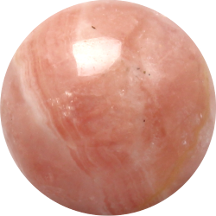
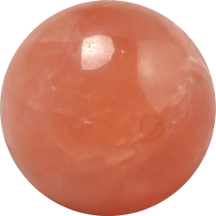
Rhodochrosite is a natural manganese carbonate mineral (MnCO3) of the calcite group, pink to rose-red in color. "Inca Rose" is a trade name for the same mineral. Banded massive material is cut into beads, cabochons and carvings; rare transparent crystals are faceted for collectors.
Products made with this material
Showing 2 of 2 products
Full material guide
What the material is, where it comes from or how it is made, identification and care, from the cited sources.
Properties
| Nature | Natural mineral (carbonate) |
| Chemical formula | MnCO3 (manganese often partly replaced by iron, magnesium or calcium) |
| Color | Pale pink to rose-red and orangish red; massive material often banded with white or gray |
| Crystal system | Trigonal |
| Mohs hardness | 3.5 to 4 |
| Specific gravity | 3.4 to 3.6 (pure 3.7) |
| Refractive index | 1.578 to 1.840 |
| Birefringence | 0.201 to 0.220 (very high) |
| Cleavage | Perfect rhombohedral, in three directions |
| Luster | Vitreous to pearly |
| Transparency | Transparent to opaque |
| Treatments | Wax or plastic impregnation of opaque material |
Origins & sources
Rhodochrosite forms in hydrothermal veins and fractures, often with silver ores, and as layered deposits in cavities, where it can build stalactites. Catamarca Province, Argentina (Capillitas), produces massive banded material and stalactites whose cross-sections show concentric "bull's-eye" patterns. The finest facetable crystals come from the Sweet Home Mine near Alma, Colorado; South Africa (Hotazel) yields deep red crystals, and other sources include Peru, Mexico, Montana, China, Japan, Romania and Russia.
Identification
Rhodochrosite is identified by its pink color, perfect cleavage in three directions, low hardness and very high birefringence, which causes strong doubling in transparent stones. It effervesces weakly in cold dilute hydrochloric acid (a destructive test). Rhodonite, a pink manganese silicate with a similar name, is harder and has darker, dendritic veining. Imitations include dyed calcite, talc-calcite aggregates and resin-bonded mineral powder layered to mimic banding (SG about 1.99, RI about 1.55). Synthetic rhodochrosite has appeared as beads and cabochons.
Care
With a hardness of only 3.5 to 4 and perfect cleavage, rhodochrosite scratches and breaks easily; it is better suited to earrings, pendants and pins than to rings or bracelets. Avoid mechanical cleaning and any acid-containing cleaners; use a soft brush, mild detergent and warm water. A jeweler's torch can damage wax- or plastic-impregnated stones. Store it apart from other gems.
History
Johann Friedrich Ludwig Hausmann named the mineral in 1813 from the Greek words for "rose" and "coloring". At the Sweet Home Mine in Colorado, opened as a silver mine in 1873, rhodochrosite was at first disregarded; its crystals later became prized specimens. Rhodochrosite is the official state mineral of Colorado.
Cultural meanings
Not collected yet
Traditional beliefs
Not collected yet
Collected Oct 23, 2026
- Rhodochrosite: Mineral information, data and localities. Mindat.org (Hudson Institute of Mineralogy) · Accessed Oct 23, 2026 OverviewPropertiesHistory
- Rhodochrosite Value, Price, and Jewelry Information International Gem Society (Joel E. Arem, Ph.D., FGA) · Accessed Oct 23, 2026 OverviewPropertiesOrigins & sourcesIdentificationCare
- Rhodochrosite: Manganese ore, gemstone, mineral specimen Geology.com (Hobart M. King, PhD) · Accessed Oct 23, 2026 OverviewPropertiesOrigins & sourcesIdentificationCareHistory