


Malachite
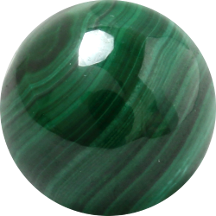
Malachite is a natural green copper carbonate hydroxide mineral, Cu2(CO3)(OH)2, and a very common secondary copper mineral. It usually forms banded, botryoidal or stalactitic masses whose cut surfaces show agate-like bands and "eyes" in light to very dark green. It is soft (Mohs 3.5 to 4) and has been used as a copper ore, a pigment, a gem and a carving material for thousands of years.
Products made with this material
Showing 1 of 1 products
Full material guide
What the material is, where it comes from or how it is made, identification and care, from the cited sources.
Properties
| Nature | Natural mineral (secondary copper mineral) |
| Mineral species | Malachite (IMA-approved species) |
| Chemical formula | Cu2(CO3)(OH)2 |
| Color | Pastel to bright to nearly black green; light green streak |
| Crystal system | Monoclinic |
| Mohs hardness | 3.5 to 4 (IGS gives up to 4.5) |
| Specific gravity | 3.6 to 4.05 |
| Refractive index | 1.655 to 1.909 (about 1.85 on massive material) |
| Cleavage | Perfect in one direction, fair in a second |
| Luster | Vitreous to adamantine in rare crystals; silky when fibrous; dull to earthy when massive; polishes brightly |
Origins & sources
Malachite forms at shallow depths in the oxidizing zone above copper deposits, precipitating from descending solutions in fractures, caverns, cavities and porous rock, often in limestone; the waxing and waning of these solutions produces its bands. It occurs with azurite, cuprite, calcite and other copper minerals. Early deposits in Egypt and Israel were mined more than 4,000 years ago, and large deposits in Russia's Ural Mountains supplied much gem material in the 1800s. Most malachite on the lapidary market today comes from the Democratic Republic of the Congo, with smaller amounts from Namibia, Australia, France, Russia and Arizona.
Identification
Malachite is easy to recognise by its green colour, banding and eyes, light green streak, low hardness and high specific gravity; it is one of few green minerals that fizz in cold dilute hydrochloric acid (streak and acid tests are destructive). It is also found intergrown with azurite (azurmalachite), chrysocolla, turquoise and pseudomalachite. Treatment is uncommon, but lower-quality, porous material may be stabilised with plastic resin or waxed. Synthetic and imitation malachite has been used in jewellery; poor imitations have an unnatural colour, and better ones usually show banding and eyes without a natural geometry.
Care
Malachite is soft, somewhat brittle and sensitive to heat and acids. Earrings, brooches and pendants pose no special problems, but rings and bracelets need protective settings. Do not use ultrasonic or steam cleaning or acidic cleaners. Wearing or displaying finished pieces is considered safe, but dust from grinding malachite is toxic to breathe because of its copper, so miners and cutters should wear respiratory protection and keep the rough wet.
History
The name goes back to the ancient "molochitus" (recorded by Pliny the Elder in 79 CE), from the Greek word for the mallow plant, alluding to the green of its leaves. Malachite may have been mined in Egypt as early as 4,000 BCE and was cut for jewellery and ground into pigment for painting and cosmetics; it is one of the oldest known green pigments and appears in Egyptian tomb paintings and European paintings of the 15th and 16th centuries. It has been used in protective amulets since ancient times. The Russian royals of the 19th century used it for vases, sculptures and panelling, as in the Malachite Room of the Winter Palace in St. Petersburg, and Victorian jewellers favoured it for carvings, beads and cabochons.
Cultural meanings
Not collected yet
Traditional beliefs
Not collected yet
Collected Oct 23, 2026
- Malachite: Mineral information, data and localities Mindat.org (Hudson Institute of Mineralogy) · Accessed Oct 23, 2026 OverviewPropertiesHistory
- Malachite: Uses and properties of the mineral and gemstone Geology.com (Hobart M. King) · Accessed Oct 23, 2026 OverviewPropertiesOrigins & sourcesIdentificationCareHistory
- Malachite Value, Price, and Jewelry Information International Gem Society (Joel E. Arem, Barbara Smigel) · Accessed Oct 23, 2026 PropertiesOrigins & sourcesIdentificationCareHistory