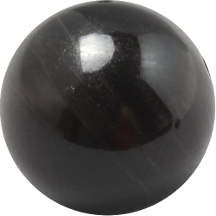
Black Tiger's Eye

Black tiger's eye is a trade name for tiger's eye, a chatoyant variety of quartz containing altered crocidolite (amphibole) fibres, with a black body colour; in the trade it is usually a treated natural material coloured by dye. The gemmologist R. Webster described black tiger's eye cabochons as obviously stained, and the Japanese retailer Pascle states that almost all of its black tiger's eye is artificially dyed, adding that rare natural material is reported but hard to tell apart.

Products made with this material

Category
Category
Color
Color

Colors are read from each product’s main photo.

Bead diameter (mm)
Bead diameter (mm)

Only round beads with a verified diameter. A product matches when its stated size range overlaps yours, limits included; a material matches when any of its round sizes does.

Price (USD)
Price (USD)
Availability

Showing 1 of 1 products

Full material guide
Material facts

What the material is, where it comes from or how it is made, identification and care, from the cited sources.

Properties

Material type Usually a treated natural material (dyed tiger's eye)
Base material Tiger's eye: quartz with included, altered crocidolite fibres
Treatment Usually dyed black
Chemical formula (quartz host) SiO₂
Mohs hardness 6.5 to 7
Specific gravity (tiger's eye) 2.55 to 2.91
Refractive index (tiger's eye) 1.544 to 1.553
Optical effect Chatoyancy (silky moving bands)
Transparency Opaque

Origins & sources

Black tiger's eye is normally coloured by dyeing, so it has no documented natural deposit of its own. Its base material, tiger's eye, comes mainly from South Africa; other recorded sources include Western Australia, India, Myanmar, Sri Lanka, Brazil, China, Namibia and the United States. Where the stones are dyed is not documented in the sources consulted; Pascle gives South Africa and Namibia as origins of its material.

Identification

Black tiger's eye looks almost black in dim light and shows a faint chatoyant band when lit, keeping the fibrous structure of tiger's eye. The gemmologist R. Webster noted that many tiger's eye cabochons are stained and that vivid greens, blues and blacks are obviously stained. GIA notes that a qualified gemologist can detect dyed gems in most cases; whether a particular black stone is dyed should be settled by testing, not by appearance alone. Fibre-optic glass can imitate the chatoyancy of these materials but is a man-made product.

Care

Because the colour usually comes from dye, keep the stones away from solvents such as alcohol or acetone, which can remove many dyes, and from prolonged sunlight, which can make some dyes fade. Jewelers commonly recommend cleaning tiger's eye only with a polishing cloth rather than alcohol, steam or an ultrasonic cleaner, and note that it chips or breaks more readily than many gems when struck.

History & culture

History

Not collected yet

Cultural meanings

The Japanese retailer Pascle says that black tiger's eye shares the meanings it gives to all colours of tiger's eye: because the "tiger's eye" was traditionally thought to see through everything, the stone is said to sharpen its wearer's insight, and the retailer associates it with luck in work and money.

Traditional beliefs

Not collected yet

Sources

Collected Oct 23, 2026