


Himalayan Quartz
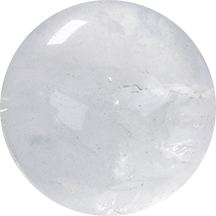
Himalayan quartz is a locality name for natural quartz (SiO₂) from the Himalaya, mostly clear rock crystal, often with green chlorite inclusions. It is not a separate mineral or variety. Much of it comes from Alpine-type fissures in gneisses and schists of the Ganesh Himal region north of Kathmandu, Nepal, and from the Kullu Valley in Himachal Pradesh, India.
Products made with this material
Showing 1 of 1 products
Full material guide
What the material is, where it comes from or how it is made, identification and care, from the cited sources.
Properties
| Material type | Natural mineral: quartz from a named region (Himalaya) |
| Chemical formula | SiO₂ |
| Mohs hardness | 7 (quartz) |
| Specific gravity | 2.65 to 2.66 (quartz) |
| Crystal system | Trigonal (quartz) |
| Common inclusions and associates | Chlorite group (often dense and green), actinolite; associated albite, adularia, titanite, anatase, rutile |
Origins & sources
According to The Quartz Page, the Himalaya was only recently recognised as a source of excellent rock crystal; much material comes from Alpine-type fissures in gneisses and metamorphosed schists of the Ganesh Himal region north of Kathmandu, and rock crystal apparently occurs along the whole east–west extent of the range. Mindat rates Ganesh Himal (Dhading District, Bagmati Province, Nepal) as a world-class quartz locality, with the Lapa and Tipling quartz mines in Ruby Valley; its specimens are commonly associated with chlorite, albite, titanite and adularia. At the Tipling Mine many crystals grew in chlorite pocket clay and are partly or completely filled with dark green chlorite. Clear crystals also come from quartz veins in quartzite in the Kullu Valley, Himachal Pradesh, India. Retailers often sell Himalayan quartz under the names of individual mountains or massifs.
Identification
Himalayan quartz has the ordinary properties of quartz, so nothing in the stone itself proves a Himalayan origin; the name depends on provenance. Labels can be wrong: The Quartz Page describes specimens sold as from "Indian Nepal" and as from Arkansas that, on comparison, were from the Kullu Valley in India. Dense green chlorite inclusions are typical of Nepalese material but also occur in quartz from Alpine-type fissures elsewhere, such as the Alps and Norway.
Care
Himalayan quartz has the durability of quartz: hardness 7, no real cleavage and very good wearability, with no special care instructions. Like all quartz it is brittle with a conchoidal fracture, so hard knocks can chip it.
History
Not collected yet
Cultural meanings
The Japanese retailer Pascle says that because the Himalaya is regarded in several religions as a sacred place closest to heaven, crystal from these mountains is believed to hold the power of the gods. The same retailer says the stone is believed to aid meditation and to have strong purifying and evil-repelling power, and it sells it as a charm for those purposes.
Traditional beliefs
Not collected yet
Collected Oct 23, 2026
- The Quartz Page: Rock Crystal The Quartz Page (A. C. Akhavan) · Accessed Oct 23, 2026 OverviewOrigins & sourcesIdentification
- The Quartz Page: Inclusions The Quartz Page (A. C. Akhavan) · Accessed Oct 23, 2026 OverviewPropertiesOrigins & sourcesIdentification
- Quartz from Ganesh Himal, Dhading District, P3 Bagmati Pradesh, Nepal Mindat.org (Hudson Institute of Mineralogy) · Accessed Oct 23, 2026 OverviewPropertiesOrigins & sources
- Quartz: Mineral information, data and localities. Mindat.org (Hudson Institute of Mineralogy) · Accessed Oct 23, 2026 PropertiesCare
- Quartz Value, Price, and Jewelry Information International Gem Society (Joel E. Arem, Donald Clark, Barbara Smigel) · Accessed Oct 23, 2026 Care
- ヒマラヤクリスタル|天然石・パワーストーン通販 Pascle(パスクル) Pascle (retailer; trade claims only) · Accessed Oct 23, 2026 Origins & sourcesCultural meanings