


Yellow Tiger's Eye
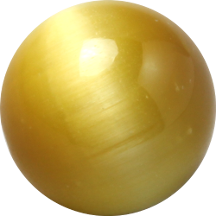
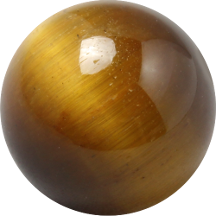
Yellow tiger's eye is the classic golden-yellow to golden-brown tiger's eye: a natural, chatoyant variety of quartz. Parallel fibres of the amphibole crocidolite (a form of riebeckite) enclosed in the quartz have weathered to iron oxides and hydroxides, which give the golden colour and the moving band of light. Mindat lists pseudocrocidolite as a synonym, and South African mining studies separate this yellow type from blue (hawk's eye) and variegated tiger's eye.
Products made with this material
Showing 2 of 2 products
Full material guide
What the material is, where it comes from or how it is made, identification and care, from the cited sources.
Properties
| Nature | Natural material (variety of quartz); colour may be bleached or dyed in trade |
| Mineral species | Quartz with included, altered crocidolite (riebeckite amphibole) fibres |
| Chemical formula | SiO₂ (quartz host) |
| Color | Golden yellow, yellow-brown to golden brown |
| Structure | Columnar quartz crystals 0.1–1.0 mm across and 1–10 mm long with aligned fibrous inclusions (fibrous aggregate) |
| Crystal system | Trigonal (quartz host) |
| Mohs hardness | 7 (IGS, Mindat); Gemdat gives 6.5 to 7 |
| Specific gravity | 2.58 to 2.64 (Gemdat); IGS gives 2.55 to 2.91 |
| Refractive index | 1.544 to 1.553 (IGS); Gemdat gives 1.534 to 1.540 |
| Cleavage and fracture | No cleavage; conchoidal fracture |
| Luster | Vitreous |
| Transparency | Opaque |
| Optical phenomenon | Chatoyancy (a moving band of light, the cat's-eye effect) |
| Treatment | May be bleached to lighten the colour or dyed; heating is used to produce red tones |
Origins & sources
Tiger's eye forms in banded iron formations: fractures in the rock were filled with fibrous crocidolite that was enclosed by quartz, and iron oxides trapped in the quartz give the golden colour. It was long explained as quartz replacing crocidolite (a pseudomorph), but Heaney and Fisher (2003) argued that quartz and fibres grew together by a crack-seal vein-filling process. Important deposits lie near Prieska in South Africa's Northern Cape, hosted in banded iron formation of the Asbestos Hills Subgroup (Transvaal Supergroup) and mined on a small scale; there the yellow type is the most sought after. GIA exhibits a slab over 3 m long from the Marra Mamba Iron Formation of Western Australia, formed from sediments about 2.5 billion years old. IGS also lists China, Namibia, England and the United States.
Identification
Look for silky bands that switch between light and dark as the stone is turned, on an opaque golden-brown fibrous body. Hawk's eye is the blue, less altered form, and both colours can occur in one piece. In the Mintek grading used in the Northern Cape, golden or honey-yellow and light-brown colour, long straight fibres and sharp chatoyant lines are the most valued. GIA notes that chatoyant glass and plastic made from fused optical fibres are cheap imitations of cat's-eye stones in any colour. Tiger's eye may be bleached or dyed; the Japanese retailer Pascle states that the lighter "golden tiger's eye" it sells is yellow tiger's eye that has been bleached.
Care
IGS rates the wearability of tiger's eye as very good; it has a hardness of about 7 and no cleavage. If a piece has been dyed, GIA advises keeping dyed gems away from solvents such as acetone or alcohol, which can dissolve dyes, and out of prolonged sunlight, which can fade them.
History
According to Mindat, the first known account of tiger's eye is by the French traveller François Levaillant, who in 1784 found a pebble on the banks of the Orange River with "a varying splendor like the opal or cat's eye" and "a gold-coloured belt". The German naturalist Martin Hinrich Lichtenstein collected tiger's eye and crocidolite along the Orange River in 1803, and the chemist Martin Heinrich Klaproth described them scientifically in 1811; Lichtenstein's specimens, labelled in Klaproth's handwriting, are kept at the Museum für Naturkunde in Berlin.
Cultural meanings
Not collected yet
Traditional beliefs
Not collected yet
Collected Oct 23, 2026
- Tiger's Eye: Mineral information, data and localities Mindat.org · Accessed Oct 23, 2026 OverviewPropertiesOrigins & sourcesHistory
- Tiger's Eye gemstone information Gemdat.org · Accessed Oct 23, 2026 OverviewPropertiesIdentification
- Tiger's Eye Value, Price, and Jewelry Information International Gem Society · Accessed Oct 23, 2026 PropertiesOrigins & sourcesIdentificationCare
- Common Gemstone Treatments Cheat Sheet International Gem Society · Accessed Oct 23, 2026 PropertiesIdentification
- Structures Behind the Spectacle: A Review of Optical Effects in Phenomenal Gemstones and Their Underlying Nanotextures (Gems & Gemology, Summer 2025) GIA · Accessed Oct 23, 2026 OverviewPropertiesOrigins & sourcesIdentification
- Tiger's-Eye Quartz (GIA Museum permanent exhibit) GIA · Accessed Oct 23, 2026 Origins & sources
- Tiger's eye in the Northern Cape Province, South Africa - grading, distribution, small-scale mining, and beneficiation potential (J. S. Afr. Inst. Min. Metall. 116(6), 2016) Journal of the Southern African Institute of Mining and Metallurgy (SciELO SA) · Accessed Oct 23, 2026 OverviewOrigins & sourcesIdentification
- An Introduction to Gem Treatments GIA · Accessed Oct 23, 2026 Care
- ゴールデンタイガーアイ (Golden Tiger's Eye) (retailer page; supplier/trade claim) Pascle (Japanese retailer) · Accessed Oct 23, 2026 Identification