


Variscite
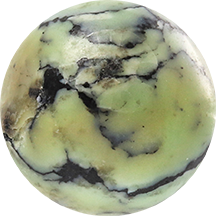
Variscite is a natural hydrated aluminium phosphate mineral (AlPO₄·2H₂O), usually yellowish green to bluish green and found as fine-grained nodules, veins and crusts. Gem material is cut into cabochons, beads and carvings and can closely resemble turquoise. It forms a series with the iron-dominant mineral strengite.
Products made with this material
Showing 1 of 1 products
Full material guide
What the material is, where it comes from or how it is made, identification and care, from the cited sources.
Properties
| Nature | Natural mineral |
| Chemical formula | AlPO₄·2H₂O |
| Color | Pale to emerald green, yellowish green, bluish green; rarely red or violet; often with yellow, brown or black matrix |
| Crystal system | Orthorhombic; crystals very rare, usually massive or nodular |
| Mohs hardness | 3.5 to 4.5 |
| Specific gravity | 2.57 to 2.61 (crystals); 2.2 to 2.5 in massive material |
| Refractive index | 1.563 to 1.594 (spot reading about 1.56–1.57) |
| Birefringence | 0.031 |
| Luster | Vitreous in crystals; waxy to dull when massive |
| Treatment | Usually untreated; may be dyed or wax/polymer impregnated, especially when passed off as turquoise; often cut as doublets |
Origins & sources
Variscite forms near the surface where phosphate-bearing waters react with aluminium-rich rocks, usually as cryptocrystalline masses, nodules, veins or cavity fillings. Its type locality is the Meßbach quarry in the Vogtland district of Saxony, Germany. The International Gem Society names Utah as the principal source of gem-quality material, with nodules up to 24 inches across from Fairfield; other sources include Nevada, Arizona, Arkansas, California, Pennsylvania and Wyoming in the USA, and Queensland (Australia), Austria, Brazil, China, the Czech Republic, Germany, Sardinia (Italy), Peru, Poland, Spain and Tajikistan.
Identification
Variscite often occurs in the same areas as turquoise and can look very similar, but it is usually greener. Standard tests separate them: variscite gives a spot refractive index of about 1.57 versus about 1.61 for turquoise, may show absorption bands near 690 and 650 nm, usually appears weakly pinkish through a Chelsea filter, and is softer. Common turquoise treatments can mask these differences. Utah material is sometimes sold as "utahlite" or "lucinite"; variscite mixed with quartz is called "amatrix". "Synthetic variscite" offered online may be a simulant rather than a true lab-grown material.
Care
With a hardness of only 3.5 to 5, variscite scratches easily, so it suits pendants, earrings and protective settings better than rings or bracelets, and should be stored away from harder gems. It is porous and can be discoloured by skin oils and cosmetics. Clean it only with a soft brush, mild soap or detergent and warm water.
History
Variscite is named after Variscia, an old name for the Vogtland district of Germany where it was first found. According to the International Gem Society, it has been used for jewellery since Neolithic times, more than 6,000 years ago: Neolithic beads found in Brittany, France, were called callaïs after a gem described by Pliny the Elder and were first thought to be turquoise, and some of this variscite came from Sardinia, pointing to a wide prehistoric gem trade in Europe.
Cultural meanings
Not collected yet
Traditional beliefs
Not collected yet
Collected Oct 23, 2026
- Variscite: Mineral information, data and localities Mindat.org · Accessed Oct 23, 2026 OverviewPropertiesOrigins & sourcesHistory
- Variscite Value, Price, and Jewelry Information International Gem Society · Accessed Oct 23, 2026 OverviewPropertiesOrigins & sourcesIdentificationCareHistory
- Variscite - A rare mineral and gem material Geology.com · Accessed Oct 23, 2026 OverviewPropertiesOrigins & sourcesIdentificationCare