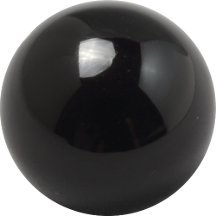
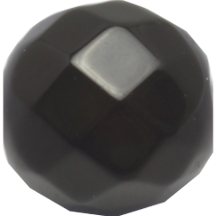
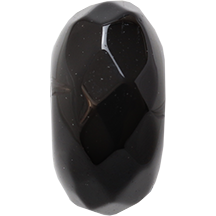
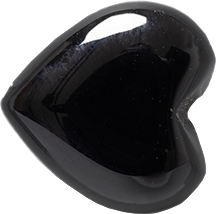
Black Onyx

"Black onyx" is the trade name for uniformly black chalcedony (microcrystalline quartz, SiO₂). Natural black chalcedony is rare: almost all black onyx on the market is grey or banded chalcedony that has been coloured black, traditionally by soaking it in sugar solution and then in sulfuric acid, which carbonises the sugar in its pores. Strictly, onyx means chalcedony with straight black-and-white bands, so black onyx is a treated natural stone rather than a separate mineral.

Products made with this material

Category
Category
Color
Color

Colors are read from each product’s main photo.

Bead diameter (mm)
Bead diameter (mm)

Only round beads with a verified diameter. A product matches when its stated size range overlaps yours, limits included; a material matches when any of its round sizes does.

Price (USD)
Price (USD)
Availability

Showing 9 of 9 products

Full material guide
Material facts

What the material is, where it comes from or how it is made, identification and care, from the cited sources.

Properties

Nature Treated natural stone (dyed black chalcedony)
Material Chalcedony (microcrystalline quartz)
Chemical formula SiO₂
Treatment Sugar solution followed by sulfuric acid (carbonised sugar in the pores); usually called dyeing; assumed for virtually all material
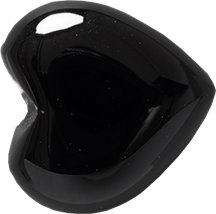
Color Uniform black, opaque
Mohs hardness 6.5 to 7
Specific gravity 2.58 to 2.64
Refractive index 1.530 to 1.540

Origins & sources

Black onyx is made from ordinary chalcedony and agate, mostly from South America; JCK names Brazil as the major source of the chalcedony seen in the United States and Uruguay as a source of fine black-and-white cameo material. The colour is produced afterwards: the stone is soaked for days or weeks in sugar solution (formerly honey) and then heated in sulfuric acid, a penetrating and permanent process that JCK says probably dates back to the Roman Empire. Pale chalcedony may first be heated to a milky white. Non-porous layers, such as the white bands of cameo material, do not take the colour.

Identification

GIA notes that black opaque materials are among the hardest gems to identify, and that various materials have been sold as "black onyx". Chalcedony is a very fine aggregate with a waxy, conchoidal fracture and a refractive index near 1.53–1.54; glass shows a vitreous fracture and may contain gas bubbles, and plastic is much lighter. With strong fibre-optic light on a thin edge, the original agate banding of a black onyx cabochon may become visible. GIA has also reported brown agate beads with a black surface coating mixed into strands of dyed black chalcedony: the coating wore off and was removed by acetone, whereas no dye could be removed from the true black chalcedony. When doubt remains, laboratories use X-ray diffraction and EDXRF.

Care

The sugar-acid colour is permanent, and JCK says ultrasonic cleaning should not be a problem for permanently enhanced chalcedony; warm water with a mild dish soap is the simplest safe method. Polished black onyx scratches fairly easily and the scratches show, so store it apart from harder stones. It is heat sensitive: jewellers should remove it before repairs such as retipping or sizing.

History & culture

History

The name comes from ancient Greek ónyx, "nail" (fingernail). Banded onyx has been carved into cameos and intaglios since antiquity; a two-layer onyx eagle cameo in the Kunsthistorisches Museum in Vienna is dated to 27 BC. According to Central Michigan University's GemRocks, for at least the last century the word onyx has often been applied only to the black layer and, in the marketplace, to any black chalcedony, natural or dyed. Marketplace black onyx is now used mainly for cabochons, beads, carvings and inlays.

Cultural meanings

In Japan's crystal trade, retailers such as Pascle present black onyx as a traditional amulet against misfortune and evil, saying it was believed from old times to ward off evil spirits. These are retail traditions, not verified properties.

Traditional beliefs

Central Michigan University's GemRocks records a story, offered as a hypothesis for the name, that onyx was formed from the fingernails of Venus, clipped by Cupid while she slept. GemRocks also quotes Merrill (1922) on an onyx ring shown in the cathedral of Perugia, said to be the betrothal ring of Mary and Joseph and believed to cure every disorder.

Sources

Collected Oct 23, 2026