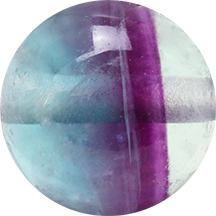
Rainbow Fluorite
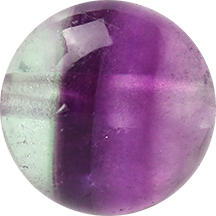
Rainbow fluorite is a trade name for natural fluorite (calcium fluoride, CaF₂) that shows two or more colors in one piece. The International Gem Society notes that lapidaries cut such multicolored gems from color-zoned crystals; fluorite crystals are frequently color zoned. Pascle, a Japanese retailer, uses the name for beads with several colors in one bead, most often green and purple, and notes it is also sold as "bicolor fluorite". It is the same mineral as other fluorite, not a separate species.
Products made with this material
Showing 2 of 2 products
Full material guide
What the material is, where it comes from or how it is made, identification and care, from the cited sources.
Properties
| Nature | Natural mineral (color variety of fluorite) |
| Mineral species | Fluorite (halide); a color variety, not a separate species |
| Chemical formula | CaF₂ |
| Color | Two or more colors in bands or zones, commonly green and purple; blue and other colors also occur |
| Cause of color | Color zoning: different zones contain different color centers linked to trace rare-earth elements (such as yttrium, cerium and samarium), oxygen and natural irradiation |
| Mohs hardness | 4 |
| Specific gravity | About 3.18 (3.0 to 3.25 for impure massive material) |
| Refractive index | 1.432 to 1.434 (isotropic) |
| Cleavage | Perfect in four directions (octahedral) |
| Possible treatments | Heating (about 100–150 °C) can lighten dark color; irradiation can darken colorless or pale material to blue, green or purple; decorative objects may be coated, dyed or impregnated with plastic |
Origins & sources
Fluorite forms mainly in hydrothermal veins, often with metallic ores, and in cavities of limestones and dolomites; it is common worldwide. Multicolored, color-zoned crystals occur at many fluorite localities. Pascle lists China and the USA as the main sources of the rainbow fluorite it sells.
Identification
Rainbow fluorite has the properties of fluorite: hardness 4, perfect cleavage in four directions, a very low refractive index (about 1.43) and specific gravity about 3.18; its color bands are part of the crystal, not a surface layer. Fluorescence is common but not diagnostic, since not all fluorite fluoresces. Color can be lightened by heating or deepened by irradiation, and decorative pieces may be coated, dyed or plastic-impregnated.
Care
Like all fluorite, it is soft (Mohs 4) and cleaves easily, so ring wear is not recommended; pendants, earrings and protective settings suit occasional wear. Store it apart from harder gems and out of strong light, since some fluorite fades with prolonged light exposure. Fluorite is slightly soluble in water: do not soak it, clean it only with a warm damp cloth, mild detergent and a soft brush, and avoid mechanical cleaning systems.
History
Banded, multicolored fluorite has long been used decoratively. The International Gem Society notes that for over 1,500 years English artisans carved Blue John (Derbyshire Spar), a fluorite variety with bands of white, blue, violet and reddish brown, into vases, bowls and other objects; the Derbyshire deposits are nearly exhausted.
Cultural meanings
Pascle, a Japanese retailer, says fluorite is sometimes called the "stone of genius" because it is said to boost imagination, and that rainbow fluorite is said to combine the meanings attributed to each of its colors.
Traditional beliefs
Not collected yet
Collected Oct 23, 2026
- Fluorite Value, Price, and Jewelry Information International Gem Society (Joel E. Arem, Ph.D., FGA) · Accessed Oct 23, 2026 OverviewPropertiesIdentificationCareHistory
- Fluorite (also known as Fluorspar) Geology.com (Hobart M. King, PhD) · Accessed Oct 23, 2026 PropertiesOrigins & sourcesIdentification
- Color Centers, Associated Rare-Earth Ions and the Origin of Coloration in Natural Fluorites (Physics and Chemistry of Minerals 3: 117–131, 1978) Bill H. & Calas G., via Archive ouverte UNIGE (University of Geneva) · Accessed Oct 23, 2026 Properties
- Pascle stone guide: Rainbow Fluorite Pascle (Japanese retailer; trade claims only) · Accessed Oct 23, 2026 OverviewOrigins & sourcesCultural meanings