


Sunstone
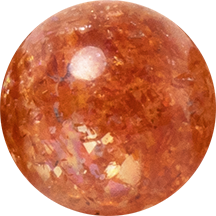
Sunstone is a feldspar gem material; its sparkling varieties contain reflective inclusions. Both orthoclase and plagioclase feldspars have sunstone varieties, so the name describes appearance rather than chemistry. Heliolite, sun stone and aventurine feldspar are alternate names.
Products made with this material
Showing 1 of 7 products
Full material guide
What the material is, where it comes from or how it is made, identification and care, from the cited sources.
Properties
| Mineral group | Feldspar; sunstone varieties occur in orthoclase and plagioclase. |
| Chemical composition | Orthoclase: KAlSi₃O₈; oligoclase and labradorite: solid solution between NaAlSi₃O₈ and CaAl₂Si₂O₈ |
| Color | Yellow, green, red, red-brown, colorless |
| Refractive index | Orthoclase sunstone 1.518 to 1.526; oligoclase sunstone 1.537 to 1.547; labradorite sunstone 1.559 to 1.568 |
| Birefringence | Orthoclase 0.005 to 0.008; oligoclase and labradorite 0.007 to 0.010 |
| Specific gravity | Orthoclase 2.58; oligoclase 2.65; labradorite 2.70 |
| Mohs hardness | 6.0 to 7.2 |
| Toughness | Poor; two cleavage directions |
Origins & sources
Sources include Oregon in the United States and Tamil Nadu in India. In Oregon, sunstone is found in ancient lava fields of the Warner Valley high-desert area in the south-central part of the state, where many varieties are unique to the region; Oregon sunstone is a transparent feldspar with copper inclusions. Finds in Norway and Siberia in the 19th century made sunstone more widely available.
Identification
Reflective inclusions can produce glitter, but not every sunstone sparkles. Goldstone is a copper-bearing glass imitation, not a sunstone alias.
The glitter is called aventurescence: a sparkly, metallic-looking luster from flat, reflective inclusions; when it is present, gemologists call the material aventurine feldspar. Small inclusions give a reddish or golden sheen, larger ones give glittering reflections. The inclusions may be hematite, copper or another mineral: Indian aventurine feldspar has a red-brown body color, while Oregon sunstone (a labradorite) contains copper and its color is natural, not the result of treatment. Material sold in the 2000s as "Tibetan sunstone" or "Tibetan andesine" was found by several laboratories likely to be pale andesine treated by copper diffusion.
Care
Clean with warm, soapy water. Avoid impacts, heat, steam and ultrasonic cleaners. Sunstone has poor toughness because of two cleavage directions, so protective settings such as pendants, earrings and pins suit it better than rings. Its color is stable to light. Feldspars are rapidly attacked by hydrochloric acid, so avoid cleaning products containing bleach; rare fracture-filled stones should only be cleaned with warm, soapy water.
History
In the early 1800s sunstone was a little-known, rare and costly gem; finds in Norway, Siberia and elsewhere later made it more widely recognized and less expensive. In Oregon, sunstone finds in the Warner Valley were reported in the early 1900s, and Native Americans in that area may have been the first collectors of these stones; a museum in Jacksonville, Oregon, displays sunstones among its Native American artifacts. The 1987 Oregon Legislature designated Oregon sunstone as the state gemstone.
Cultural meanings
Oregon sunstone is the official state gemstone of Oregon, designated by the state legislature in 1987.
Traditional beliefs
According to a Native American legend recounted by GIA, the blood of a great warrior wounded by an arrow dropped onto pieces of Oregon sunstone; the legend says his blood carried his warrior spirit into the stones, coloring them red and giving them sacred power. This is a legend, not an established property.
Collected Oct 22, 2026
- Sunstone Description Gemological Institute of America (GIA) · Accessed Oct 22, 2026 OverviewPropertiesOrigins & sourcesIdentification
- Sunstone Care and Cleaning Gemological Institute of America (GIA) · Accessed Oct 22, 2026 PropertiesCare
- Sunstone Buyer’s Guide Gemological Institute of America (GIA) · Accessed Oct 22, 2026 Identification
- TERMIUM Plus: sunstone / sun stone / heliolite Government of Canada, Translation Bureau · Accessed Oct 22, 2026 Overview
- Sunstone Gemstone | Sunstone Stone – GIA Gem Encyclopedia Gemological Institute of America (GIA) · Accessed Oct 22, 2026 OverviewPropertiesOrigins & sourcesIdentification
- Sunstone History and Lore Gemological Institute of America (GIA) · Accessed Oct 22, 2026 Origins & sourcesHistoryTraditional beliefs
- Sunstone: Mineral information, data and localities. Mindat.org (Hudson Institute of Mineralogy) · Accessed Oct 22, 2026 OverviewIdentification
- State of Oregon: Blue Book - Oregon Almanac: Dance to Hops Production Oregon Secretary of State · Accessed Oct 22, 2026 HistoryCultural meanings