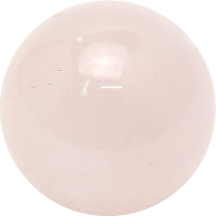
Morganite
Morganite is the pink to orange-pink variety of beryl, the natural mineral species that also includes emerald and aquamarine. Its colour is caused by traces of manganese, and it is usually light in tone. Untreated morganite often has an orange component that gives a salmon or peach colour; much of it is heated to make it pinker.
Products made with this material
Showing 2 of 2 products
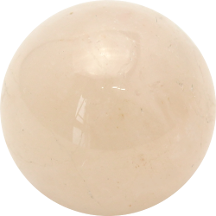
Full material guide
What the material is, where it comes from or how it is made, identification and care, from the cited sources.
Properties
| Nature | Natural mineral (often heat treated) |
| Mineral species | Beryl |
| Chemical formula | Be₃Al₂Si₆O₁₈ |
| Color | Pink to orange-pink, often light in tone |
| Crystal system | Hexagonal |
| Refractive index | 1.583 to 1.590 |
| Birefringence | 0.007 to 0.008 |
| Specific gravity | 2.80 to 2.91 |
| Mohs hardness | 7.5 to 8 |
Origins & sources
Like many pegmatite gems, morganite can form large crystals; miners in Brazil have found crystals of about 10 kg. Most morganite on the market comes from pegmatite mines in Minas Gerais, Brazil. Afghanistan, Mozambique, Namibia and the United States (California, Maine) have been minor and inconsistent sources. The original Madagascar deposit is only a minor producer today but still sets the standard for magenta-coloured rough.
Identification
Morganite shows distinct pleochroism, pale pink and a deeper bluish pink, and may contain liquid inclusions with gas bubbles; faceted stones usually have no eye-visible inclusions. Heat and light remove the yellow component of peach beryl, so morganite is often heated to get pinker stones; it is occasionally irradiated, but that colour fades in light. Hydrothermally grown synthetic morganite is sold, so a laboratory is needed to confirm natural origin. Calling morganite "pink emerald" is incorrect: it is a different variety of beryl.
Care
Morganite free of inclusions or fractures may be cleaned with mechanical systems, but have a gemologist check a stone for weaknesses first. A soft brush, mild detergent and warm water are always safe.
History
After a new locality for rose beryl was discovered in Madagascar in 1910, George Kunz proposed the name morganite at a meeting of the New York Academy of Sciences on 5 December 1910, honouring the financier J. P. Morgan for his support of the arts and sciences and his gifts of gems to museums in New York and Paris. Tiffany & Co. then introduced the gem to the American market. One of the largest specimens, the roughly 23 by 30 cm "Rose of Maine", was found at the Bennett Quarry in Buckfield, Maine, on 7 October 1989.
Cultural meanings
Not collected yet
Traditional beliefs
Not collected yet
Collected Oct 23, 2026
- What Is Morganite Gemstone | Morganite Stone GIA · Accessed Oct 23, 2026 OverviewPropertiesOrigins & sourcesIdentificationHistory
- Morganite Description GIA · Accessed Oct 23, 2026 Origins & sources
- Morganite History and Lore GIA · Accessed Oct 23, 2026 Origins & sourcesHistory
- Morganite Value, Price, and Jewelry Information International Gem Society · Accessed Oct 23, 2026 OverviewPropertiesOrigins & sourcesIdentificationCareHistory