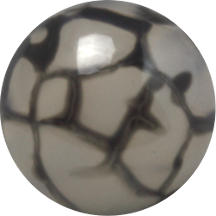
Dragon Agate

Dragon agate (also sold as dragon vein agate) is a trade name for natural agate or chalcedony whose scale-like network of lines is man-made: the stone is heated and quenched to crack it, and dye is then drawn into the cracks. The base is a natural stone, but the pattern and most colours are treatments, so it should be described as treated (crackled and dyed) agate. GIA warns that such crackled chalcedony is sometimes misrepresented as fire agate.

Products made with this material

Category
Category
Color
Color

Colors are read from each product’s main photo.

Bead diameter (mm)
Bead diameter (mm)

Only round beads with a verified diameter. A product matches when its stated size range overlaps yours, limits included; a material matches when any of its round sizes does.

Price (USD)
Price (USD)
Availability

Showing 1 of 1 products

Full material guide
Material facts

What the material is, where it comes from or how it is made, identification and care, from the cited sources.

Properties

Nature Treated natural stone (crackled and dyed agate/chalcedony)
Material Chalcedony (microcrystalline quartz), often showing agate banding
Treatment Quench crackling (heating, then rapid cooling) followed by bleaching and/or dyeing along the cracks
Color Pascle's beads: black pattern on a white base; red, green, blue, pink and other colours are dyed
Refractive index About 1.53 to 1.54 (chalcedony)

Origins & sources

Dragon agate is produced, not found: the starting material is ordinary natural agate or chalcedony. In its Winter 2009 Lab Notes, GIA reported an abundance of this kind of quench-crackled chalcedony at the Tucson gem shows, first in carnelian colour with white lines and later in dyed green, blue and pink, sold under names such as "Fire Dragon Veins Agate" and "Crackle Fire Agate"; in 2020 GIA Tokyo examined a blue variety. The Japanese retailer Pascle states that its dragon agate is made by artificially cracking agate or chalcedony and soaking dye into the cracks, and lists Uruguay, Greece and Mexico as sources (supplier claim, not independently verified).

Identification

Under magnification the coloured or white lines follow a network of fractures typical of quench crackling, and the colour penetrates only a short distance on either side of them. In beads cut in half, GIA found that the fractures reach a roughly uniform depth below the surface rather than running through the stone; GIA knows of no natural process that forms such cracks in chalcedony. Underlying agate banding and a chalcedony refractive index (about 1.53) confirm the base material. Some beads sold as dragon vein agate are reported by traders to be glass instead of chalcedony; testing the refractive index and looking for gas bubbles helps to tell them apart. This material is not fire agate, which shows iridescent colours in a brown body.

Care

Because the colour or pattern is produced by treatment, follow GIA's advice for treated gems: heat, solvents, steam and ultrasonic cleaners can affect treatments, so clean only with warm water, a mild dish soap and a soft brush, rinse and dry.

History & culture

History

Not collected yet

Cultural meanings

The Japanese retailer Pascle gives dragon agate the meanings it associates with all agate and chalcedony, sharing and togetherness, and says it is believed to help relationships. Pascle itself notes that the pattern is not natural. This is a retail tradition, not a verified property.

Traditional beliefs

Not collected yet

Sources

Collected Oct 23, 2026