


Carnelian
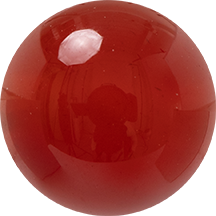
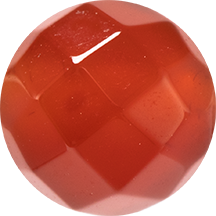
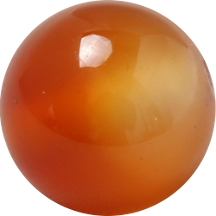
Carnelian (also spelled cornelian) is a translucent orange, reddish or brownish-red variety of chalcedony, the microcrystalline form of quartz (SiO₂). Its color comes from iron oxide impurities. The closely related, darker and browner sard is not sharply separated from carnelian.
Products made with this material
Showing 3 of 8 products
Full material guide
What the material is, where it comes from or how it is made, identification and care, from the cited sources.
Properties
| Mineral species | Quartz (chalcedony variety) |
| Chemical formula | SiO₂ |
| Color | Orange, red, orange-red to brownish red |
| Transparency | Translucent to semi-opaque |
| Luster | Waxy to resinous |
| Refractive index | 1.535 to 1.539 |
| Birefringence | 0.003 to 0.009 |
| Specific gravity | 2.58 to 2.64 |
| Mohs hardness | 6.5 to 7 |
| Cleavage | None; uneven, splintery to conchoidal fracture |
Origins & sources
Carnelian forms, like other chalcedony, as crusts or fillings in cavities such as vesicles and fissures in volcanic and other rocks. Sources cited for carnelian include Brazil and Uruguay, India, Egypt, Ratnapura (Sri Lanka), Yanacodo (Peru), Indonesia, Iran, Russia (Siberia), Germany, Queensland (Australia), and Arizona, the Colorado–Utah border area and Washington (USA).
Identification
Carnelian is translucent, which separates it from similarly colored jasper, which is opaque. The boundary between carnelian and the browner, darker sard is arbitrary and the two names are sometimes used interchangeably. "Cornelian" is an older (British) spelling of the same name.
Treatments are common: chalcedony contains finely dispersed iron compounds, so heating can turn greenish, yellowish or brown chalcedony red, and some material sold as carnelian is produced this way; this heating is stable and generally undetectable. Chalcedony is also porous and is often dyed, including red or sard-colored dyed material.
Care
Chalcedony, including carnelian, is a tough material with excellent wearability and suits all types of jewelry. It needs no special care: clean it with mild detergent, warm water and a soft brush.
History
Red chalcedony was used for beads as early as the Early Neolithic in Bulgaria, and faceted carnelian beads are known from the Varna Chalcolithic necropolis (mid-5th millennium BC). The Indus Valley Civilization made etched carnelian beads in the 3rd millennium BC, some of which reached Susa in Mesopotamia, and carnelian appears in Minoan decorative arts at Knossos around 1800 BC. The Romans widely used carnelian for engraved gems in signet rings, because hot sealing wax does not stick to it. The word "cornelian" dates from the 14th century and comes from Medieval Latin corneolus, from cornum, the cornel cherry; "carnelian" is a later 16th-century form influenced by Latin caro, carnis ("flesh").
Cultural meanings
Today carnelian is considered by some people to be a birthstone for July and by others to be associated with the zodiac sign Virgo. Some scholars count carnelian, with other chalcedonies such as sard, onyx and agate, among the stones of the high priest's breastplate described in the Bible.
Traditional beliefs
Carnelian was traditionally recommended to people with a weak voice or a reluctance to speak, in the belief that carrying or wearing it lent courage to speak out clearly and loudly. According to Merrill (1922), it was believed that wearing carnelian ensured victory in all contests except those of love. Napoleon is recorded as carrying a carnelian he found in Egypt and having faith in it as a talisman. These are historical beliefs, not established properties.
Collected Oct 22, 2026
- Carnelian: Mineral information, data and localities. Mindat.org (Hudson Institute of Mineralogy) · Accessed Oct 22, 2026 OverviewPropertiesIdentificationHistory
- Carnelian Wikipedia · Accessed Oct 22, 2026 OverviewPropertiesOrigins & sourcesIdentificationHistory
- Chalcedony Value, Price, and Jewelry Information International Gem Society · Accessed Oct 22, 2026 OverviewPropertiesOrigins & sourcesIdentificationCare
- GemRocks: Chalcedony Central Michigan University (GemRocks, W. A. Dietrich) · Accessed Oct 22, 2026 OverviewOrigins & sourcesIdentificationHistoryCultural meaningsTraditional beliefs