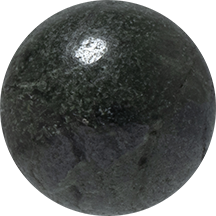
Kamuikotan Stone

Kamuikotan stone (Kamuikotan-seki) is a natural metamorphic rock, not a single mineral: a hard, compact, dark blue-green to black rock collected as river boulders in the Kamuikotan gorge of the Ishikari River in Asahikawa, Hokkaido. Japanese reference works describe it as an alkali-amphibole-bearing mafic to siliceous metamorphic rock, and it is one of Hokkaido's best-known viewing stones (suiseki) and garden stones.

Products made with this material

Category
Category
Color
Color

Colors are read from each product’s main photo.

Bead diameter (mm)
Bead diameter (mm)

Only round beads with a verified diameter. A product matches when its stated size range overlaps yours, limits included; a material matches when any of its round sizes does.

Price (USD)
Price (USD)
Availability

Showing 1 of 1 products

Full material guide
Material facts

What the material is, where it comes from or how it is made, identification and care, from the cited sources.

Properties

Nature Natural rock (metamorphic)
Rock type Alkali-amphibole-bearing mafic to siliceous metamorphic rock; a 1955 Geological Survey of Japan map explanation identified the stones under the microscope as riebeckite–quartz schist or glaucophane-bearing diabase
Geological unit Kamuikotan metamorphic rocks (low-temperature, high-pressure metamorphic rocks)
Color Dark blue-green to black; also described as black, blue-green and grape-purple, with a naturally smooth, glossy surface

Origins & sources

The stones come from the Kamuikotan gorge, where the Ishikari River cuts through metamorphic rocks west of central Asahikawa. The gorge is the type locality of the Kamuikotan metamorphic rocks, formed deep in an accretionary complex by low-temperature, high-pressure metamorphism during westward subduction of oceanic crust that continued into the Late Cretaceous. According to the 1955 survey, especially hardened parts of the rock escaped weathering, remained as rounded blocks in the soil and were further smoothed after falling into the river; blocks of one to several tonnes were removed in their natural shape as garden stones.

Identification

Kamuikotan stone looks similar to serpentinite but is very hard. It is valued for a smooth, lustrous skin even without polishing, which earned it the popular nickname abura-ishi ("oil stone"); because the rock is so hard, strongly varied shapes are uncommon, and mountain, rock and island shapes are typical.

Care

Not collected yet

History & culture

History

Kamuikotan is an Ainu place name; the Hokkaido geosite description explains it as "the place where the demon god lives". The rapids were a dangerous passage for boats and later for railways and roads. Potholes worn into the riverbed were traditionally said to be the demon god's footprints, a legend recorded by the explorer Matsuura Takeshiro in his Ishikari diary; the potholes are an Asahikawa city natural monument and the gorge's metamorphic rocks are among Japan's 100 selected geological sites. Kamuikotan stone is known throughout Japan as a suiseki and garden stone.

Cultural meanings

Not collected yet

Traditional beliefs

Not collected yet

Sources

Collected Oct 23, 2026