


Sanukite
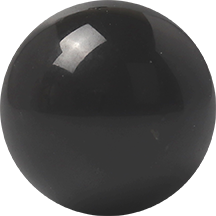
Sanukite is a natural volcanic rock from Japan, a black, dense and very hard glassy andesite (a kind of bronzite andesite). It is named after Sanuki, the old name of Kagawa Prefecture, and is found mainly around Goshikidai and on Kanayama and Shiroyama in Sakaide, Kagawa, and in the Nijōsan area on the Osaka–Nara border. When struck it rings with a clear, metallic tone, so it is locally called "kankan-ishi".
Products made with this material
Showing 1 of 1 products
Full material guide
What the material is, where it comes from or how it is made, identification and care, from the cited sources.
Properties
| Nature | Natural volcanic (igneous) rock |
| Rock type | Bronzite andesite; glassy andesite to dacite with 2 % or less phenocrysts |
| Minerals | Phenocrysts usually of olivine and orthopyroxene (rarely hornblende, augite, plagioclase); groundmass of glass with fine orthopyroxene and magnetite and almost no plagioclase |
| Color | Black; weathered surfaces grey to white |
| Geologic age | Miocene, about 13 million years old |
Origins & sources
Sanukite formed from lava erupted during volcanic activity in the Seto Inland Sea region about 13 million years ago; it caps the mesa-like hills of northern Kagawa such as Goshikidai and Yashima. Known sources are very few: around Goshikidai, Kanayama and Shiroyama in Sakaide, the Nijōsan area on the Osaka–Nara border, and a few other places. The best-sounding sanukite comes only from a very limited area near Kokubudai on Goshikidai. Related "sanukitoid" rocks occur in the Setouchi volcanic belt from eastern Kyushu to Aichi Prefecture.
Identification
Sanukite is black, dense and hard, with fewer visible crystals (phenocrysts) than ordinary basalt or andesite. When broken it gives sharp edges and shell-like (conchoidal) fractures, and when tapped it gives a high, metallic, ringing sound with a pleasant resonance. Weathered pieces from Goshikidai can take unusual grey-to-white surface forms described as worm-eaten, rotten-wood, pine-cone or katsuobushi (dried-bonito) shapes.
Care
Not collected yet
History
Sanukite was used for stone tools in Kagawa from about 30,000 years ago until the end of the Yayoi period about 1,700 years ago, mainly as cutting blades, arrowheads and stone knives. At the Palaeolithic sites excavated during construction of the Seto Ōhashi Bridge (about 130,000 pieces at Yoshima-Seihō and about 350,000 at Hazashima), nearly 98 % of the stone tools and fragments were sanukite. In 1891 the German petrologist Weinschenk named the rock "Sanukit" after Sanuki; according to the Geological Society of Japan he studied samples that Naumann, the first professor of geology at Tokyo Imperial University, had taken back to Germany, while the Kagawa University Museum says Weinschenk came to Japan to study it. The English form "sanukite" became the international name. The Geological Society of Japan lists it as the representative rock of Kagawa Prefecture.
Cultural meanings
Not collected yet
Traditional beliefs
Because of its ringing tone, sanukite has long been called "kankan-ishi" in Sanuki, and since the Edo period it has also been known as "keiseki" (chime stone). It has been used for stone xylophones and other musical instruments and for signalling, and sanukite pieces are sold as local souvenirs.
Collected Oct 23, 2026
- サヌカイト(岩石) Kagawa University Museum · Accessed Oct 23, 2026 OverviewPropertiesOrigins & sourcesIdentificationHistoryTraditional beliefs
- サヌカイト(カンカン石) Sakaide City (Culture Promotion Division) · Accessed Oct 23, 2026 OverviewPropertiesOrigins & sourcesIdentificationHistoryTraditional beliefs
- 「県の石」:四国・中国 The Geological Society of Japan · Accessed Oct 23, 2026 OverviewPropertiesHistoryTraditional beliefs