


Kyanite
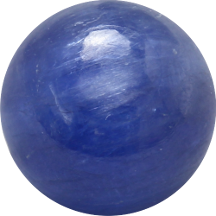
Kyanite is an aluminum silicate mineral (Al₂SiO₅) that forms during the regional metamorphism of clay-rich sediments. It shares its chemistry with andalusite and sillimanite (polymorphs). It is most often blue and grows as elongated blades whose hardness varies with direction. Synonyms include cyanite and disthene (also spelled distene). It is a raw material for refractory porcelain, and clear, deep blue material is cut as a gemstone.
Products made with this material
Showing 1 of 6 products
Full material guide
What the material is, where it comes from or how it is made, identification and care, from the cited sources.
Properties
| Mineral species | Kyanite |
| Chemical formula | Al₂SiO₅ |
| Color | Blue (most common), also white, gray, green; rarely yellow, orange or pink |
| Crystal system | Triclinic; bladed, flattened and elongated crystals |
| Refractive index | 1.710 to 1.734 |
| Birefringence | 0.017 |
| Specific gravity | 3.53 to 3.68 |
| Mohs hardness | 4 to 7.5, varying with direction (about 4 to 4.5 along the length of a crystal, 6 to 7.5 across it) |
| Cleavage | Perfect |
| Luster | Vitreous; pearly on cleavage |
| Transparency | Transparent to translucent |
Origins & sources
Kyanite forms in metamorphic rocks under moderately high pressure and indicates deep burial of the host terrain. It occurs mainly as blades in schists and gneisses, often with garnet, quartz, mica and staurolite, and also in granite pegmatites. Notable sources of gem-quality material include Brazil (large blue and blue-green crystals), Kenya, Mozambique (dark blue), Nepal, Tanzania, Switzerland and several U.S. states such as North Carolina; it is also found in Austria, India, Italy, Madagascar, Myanmar, Namibia and Zimbabwe. South Africa, the United States, France and India are the leading producers of industrial kyanite.
Identification
Kyanite is recognized by its color, perfect cleavage, bladed crystals and strongly directional hardness. Blue stones show pronounced pleochroism (violet-blue, colorless and cobalt blue), and color zoning is common; a color change from greenish blue in daylight to purple in incandescent light and, rarely, chatoyancy have been reported. Kyanite is sometimes presented as a look-alike for blue sapphire, but its refractive index, optic character and specific gravity differ.
Heating pale blue kyanite to about 1,200 °C may remove its color. Kyanite has been synthesized only for research; beads sold online as "synthetic kyanite" are most likely look-alike materials.
Care
Because of its perfect cleavage and variable hardness, kyanite set in rings should have protective settings; earrings, pendants and brooches are better suited to it. Most kyanites are heavily included, so do not use steam or ultrasonic cleaners. Clean only with a soft brush, mild detergent and warm water.
History
Abraham Gottlob Werner named kyanite in 1789 from the Greek word kyanos, "blue", after the mineral's usual color. The French spelling "cyanite" was commonly used by mineralogists through much of the 19th and early 20th centuries. The mineral was also once commonly called "disthene", meaning "two strengths", a reference to its different hardness in different directions.
Cultural meanings
Not collected yet
Traditional beliefs
Not collected yet
Collected Oct 22, 2026
- Kyanite: Mineral information, data and localities. Mindat.org (Hudson Institute of Mineralogy) · Accessed Oct 22, 2026 OverviewPropertiesOrigins & sourcesHistory
- Kyanite Value, Price, and Jewelry Information International Gem Society (Joel E. Arem, Ph.D., FGA) · Accessed Oct 22, 2026 OverviewPropertiesOrigins & sourcesIdentificationCare
- Kyanite | Metamorphic, Aluminium Silicate, Mohs Scale Encyclopaedia Britannica · Accessed Oct 22, 2026 OverviewPropertiesOrigins & sources
- Kyanite gemstone information Gemdat.org (Hudson Institute of Mineralogy) · Accessed Oct 22, 2026 PropertiesIdentification
- Kyanite Mineral | Uses and Properties Geology.com (Hobart M. King, PhD) · Accessed Oct 22, 2026 OverviewPropertiesIdentificationHistory